
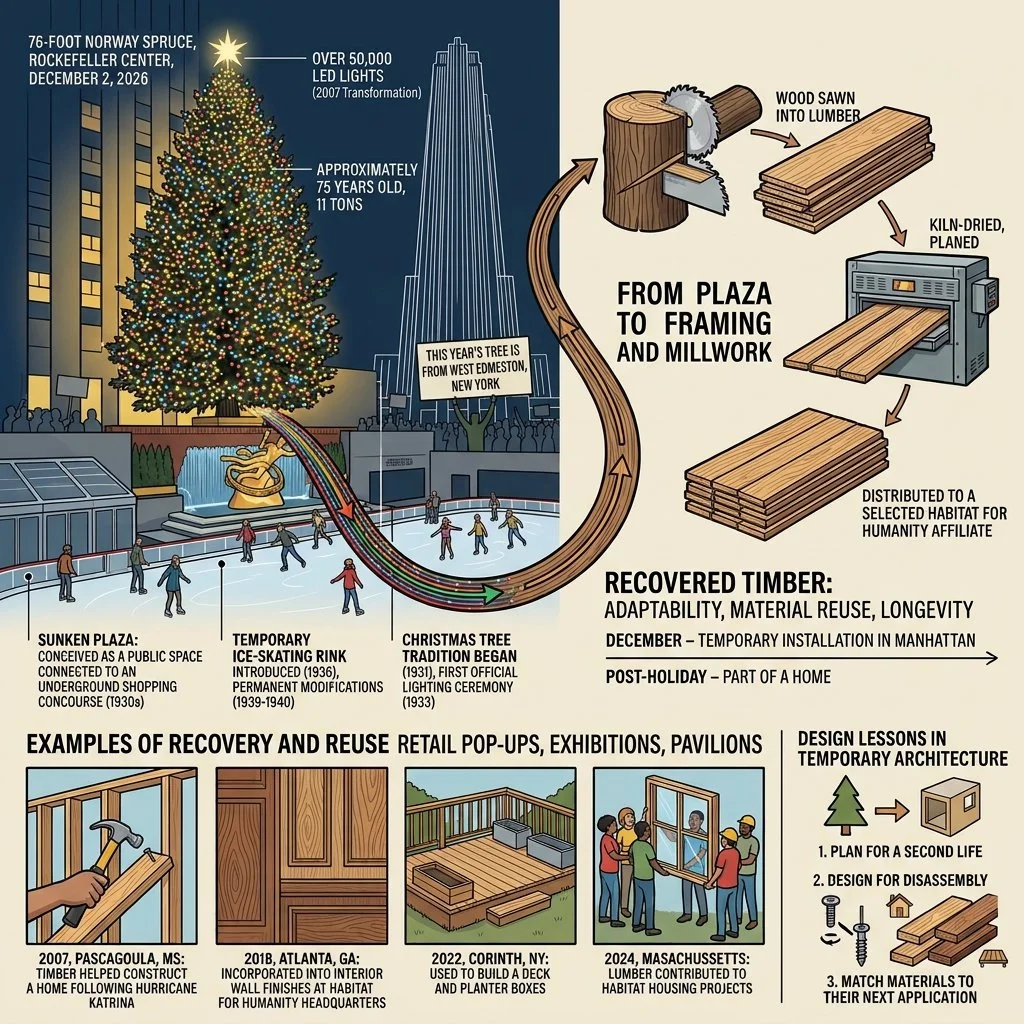
On December 2, 2026, more than 50,000 LED lights will illuminate a 76-foot Norway spruce at Rockefeller Center. Millions will recognize it as one of New York City's most familiar holiday landmarks, but the tree's story continues long after the lights go out.
This year's tree comes from West Edmeston, New York. It is approximately 75 years old and weighs around 11 tons. After the holiday season, it will be milled into lumber and donated to Habitat for Humanity, continuing a partnership that began in 2007.
For several weeks, the spruce becomes the centerpiece of a celebrated public space. Afterward, its timber can become part of a home. Both stages offer an architectural perspective on adaptability, material reuse, and longevity.
A Plaza That Found Its Best Use
The tree is inseparable from the architecture surrounding it.
From Fifth Avenue, the Channel Gardens descend between La Maison Française and the British Empire Building, leading pedestrians toward the sunken plaza. Paul Manship's gilded Prometheus anchors the composition, with 30 Rockefeller Plaza rising behind it. The Christmas tree stands along this central visual axis.
Yet neither the tree nor the skating rink was part of the plaza's original architectural program.
The sunken plaza was conceived as a public space connected to an underground shopping concourse. When the surrounding retail spaces struggled to attract visitors, management introduced a temporary ice-skating rink in 1936. Its success led to permanent modifications by 1939–1940.
The Christmas tree tradition began earlier, in 1931, when Rockefeller Center construction workers decorated a 20-foot balsam fir with handmade garlands and materials from the construction site. The first official lighting ceremony followed in 1933, featuring approximately 700 lights.
Nearly a century later, the plaza demonstrates how a strong architectural framework can accommodate changing uses. Although the space has undergone physical modifications, its defining relationships between buildings, gardens, and public gathering areas remain recognizable.
2007: The Year the Tree's Lifecycle Changed
The original Rockefeller Center Christmas tree carried a few hundred lights. Today's installation features more than 50,000 LEDs across approximately five miles of wire. A significant transformation occurred in 2007, when Rockefeller Center introduced energy-efficient lighting and began donating its Christmas trees to Habitat for Humanity. That year's display used approximately 30,000 LEDs. According to figures announced at the time, daily lighting electricity consumption was expected to decrease from 3,510 to 1,297 kilowatt-hours. Tishman Speyer, Rockefeller Center's owner and operator, also installed 363 solar panels on the roof of 45 Rockefeller Plaza, connecting renewable electricity generation to the complex's electrical network. More importantly for the tree's material lifecycle, 2007 established a process for recovering its timber after the holidays.
Rather than discarding the spruce after its temporary installation, Rockefeller Center began working with Habitat for Humanity to incorporate the wood into housing projects. Although transportation and processing still have environmental impacts, the program allows usable material to serve another purpose.
From Plaza to Framing and Millwork
Once the holiday season ends, the tree is removed and its trunk is cut into manageable sections before being transported to a New Jersey mill.
The wood is sawn into lumber, kiln-dried, planed, and distributed to a selected Habitat for Humanity affiliate. Depending on its condition, grading, and project requirements, it can be used for blocking, interior finishes, cabinetry, decking, or other building components.
A single spruce cannot supply the lumber necessary to construct an entire house, but its material can contribute to specific architectural elements.
Habitat has documented several examples:
2007, Pascagoula, Mississippi: Lumber from the first donated tree helped construct a home following Hurricane Katrina.
2018, Atlanta, Georgia: Timber was incorporated into interior wall finishes at Habitat for Humanity's headquarters.
2022, Corinth, New York: Recovered wood was used to build a deck and planter boxes for a Habitat homeowner.
2024, Massachusetts: Lumber contributed to Habitat housing projects in Pittsfield and Housatonic.
These examples demonstrate how a single material can serve different functions depending on its properties and the needs of each project. Rockefeller Center's head gardener, Erik Pauzé, typically selects mature spruces that are approaching their maximum height or becoming too large for their properties. The organization also works with donors to replenish their landscapes with new trees or greenery. The process connects a temporary installation in Manhattan to a longer cycle of material recovery and reuse.
Design Lessons in Temporary Architecture
The Rockefeller Center tree offers lessons that extend beyond holiday installations. Retail pop-ups, exhibitions, temporary pavilions, and seasonal structures can all benefit from considering what happens after their initial use.
1. Plan for a second life
Material recovery should be considered early in the design process, not only when a project is dismantled. Identifying potential future applications can help reduce unnecessary waste.
2. Design for disassembly
Mechanically fastened components and reversible connections generally allow materials to be recovered more easily than permanently bonded assemblies. Accessibility and the ability to separate materials are important considerations.
3. Match materials to their next application
Recovered materials must be evaluated for their condition and performance. The Rockefeller Center spruce demonstrates how timber can be repurposed for different architectural applications without assuming every piece is suitable for structural use.
4. Create an adaptable architectural framework
Rockefeller Center's plaza has supported changing activities for nearly a century. Its ability to accommodate new uses, while preserving its defining spatial character, offers an example of architectural longevity. The Rockefeller Center Christmas tree is temporary by design. The plaza surrounding it is not. Through the Habitat partnership, portions of the tree may continue serving a practical purpose long after the holiday display disappears. Together, they illustrate two approaches to lasting architecture: designing spaces capable of adapting over time and finding new purposes for materials when their original use ends.
Rockefeller Center's plaza has supported changing activities for nearly a century.