
From Rubble to Refinement: Why Terrazzo Is the Original "Circular Economy" Floor
When we walk through the lobby of the Empire State Building, a mid-century school, or a modern airport terminal, we often at the floor. We see a smooth, speckled surface that feels permanent and utilitarian.
This material is terrazzo. While it is currently enjoying a massive resurgence in interior design, few people realize that it was not invented as a luxury finish. It was born out of poverty and ingenuity.
Long before "sustainability" became a global priority and centuries before the concept of the "circular economy" existed, Venetian construction workers invented terrazzo as a way to turn construction waste into something beautiful.
The Venetian Origins (14th–15th Century)
The story of terrazzo begins in Venice, Italy. At the time, marble was the material of choice for the grand palazzos of the wealthy. The stone masons who cut and placed these massive slabs generated huge piles of "waste," oddly shaped chips and heavy dust that were deemed useless.
While legend holds that workers began scavenging these remnants to pave their own homes because they couldn't afford marble, the invention of terrazzo was actually driven by a critical engineering necessity, the Venetian lagoon itself.
Venice is built on unstable mud and wood pilings. As the buildings settled and shifted over time, rigid single-slab stone floors would snap and crack. The builders needed a material that offered elasticity and lightness.
They found the solution by mixing the scavenged marble waste with lime and crushed brick (known as cocciopesto). Unlike rigid stone, this lime-based mixture created a "monolithic" surface that was flexible enough to move with the building's settlements without fracturing. It was also waterproof, a vital feature for a city built on water.
Workers smoothed this mixture down with hand stones (galera). To seal the surface and bring out the color of the marble, they didn't use chemical sealants. They used the only coating available to them: goat’s milk. The fats in the milk acted as a sealer, giving the floor a slight sheen and protecting it from stains.
Thus, terrazzo was born not just from poverty, but from structural genius: turning waste into a floor that could survive where solid stone could not.
The American Evolution: Art Deco and Electricity
Terrazzo migrated to the United States in the late 19th century, brought by Italian immigrants. However, it remained a niche, labor-intensive material until the 1920s, when two inventions transformed it from a manual craft into an architectural staple.
1. The Electric Grinder: Early terrazzo had to be polished by hand using a long pole tool called a galera. It was back-breaking work. The invention of the electric grinder allowed for a smoother finish in a fraction of the time.
2. Divider Strips: Because terrazzo is essentially concrete, it cracks as it cures and shrinks. Architects introduced brass and zinc divider strips to create control joints. This solved the cracking problem and inadvertently created the geometric, Art Deco patterns that defined the style of 1920s New York and Chicago.
The Sustainability Argument (Truth over Agreement)
In modern sustainable design, we often look for high-tech materials. However, terrazzo remains a compelling alternative to modern flooring products (like luxury vinyl tile or epoxy) for three specific reasons.
• The Ultimate Recycled Product: Terrazzo is defined by its aggregate. While traditional versions use marble chips, modern terrazzo is a receptacle for waste. We can mix in crushed post-consumer glass, porcelain, recycled beer bottles, and even plastic. It allows architects to take a waste stream and sequester it permanently in a floor.
• Durability as Sustainability: The most sustainable material is the one you never have to replace. A vinyl floor might last 10 to 15 years before it ends up in a landfill. A terrazzo floor frequently outlives the building itself. In many renovation projects, 100-year-old terrazzo is simply re-polished rather than replaced.
• Indoor Air Quality: Unlike carpets (which trap allergens) or synthetic laminates (which can off-gas Volatile Organic Compounds), cementitious terrazzo is inorganic and chemically stable. It does not compromise the air quality of the interior.
The Reality of Cost
If terrazzo is so perfect, why isn't it used everywhere? The "Truth over Agreement" answer is simple: cost and weight.
Terrazzo it’s heavy and artisan material. It requires skilled labor to pour, grind, and polish on-site. It is significantly more expensive upfront than wood, tile, or carpet.
In conclusion
Terrazzo teaches us a valuable lesson about the future of materials. It reminds us that "waste" is often just a resource we haven't figured out how to use yet. The Venetian workers of the 1400s didn't know they were inventing a sustainable design feature; they were simply trying to make something durable out of the rubble left behind. Five hundred years later, we are still trying to catch up to their logic.
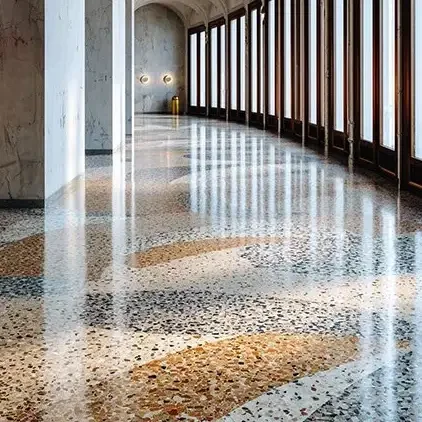
Terrazzo teaches us a valuable lesson about the future of materials.