
Why New NYC Buildings Have Dots on the Glass
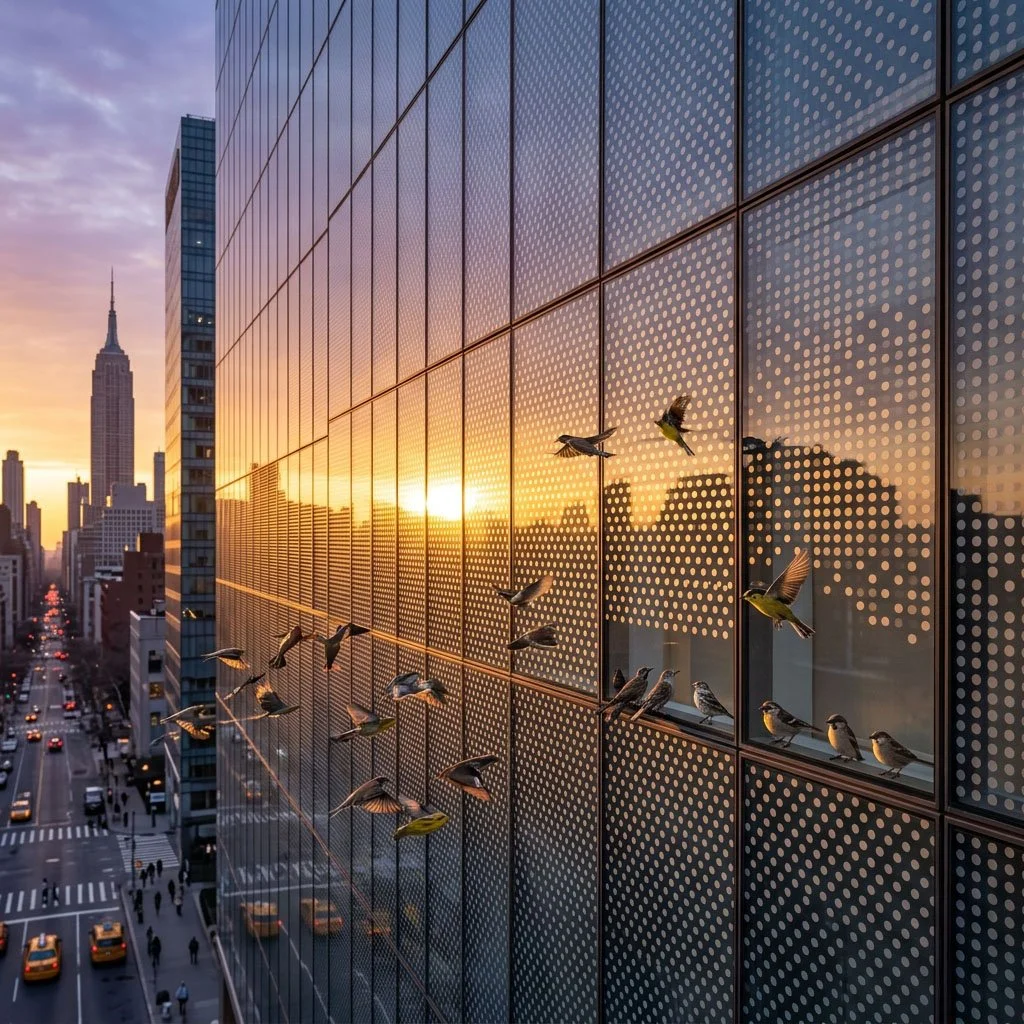
Look closely at the lower stories of many new buildings going up in New York and you may notice something on the glass. Faint dots, thin lines, or another regular pattern spread across the facade. From the street, they can look like a texture or a manufacturing detail. They are neither. In many cases, they are there because New York City now requires bird-friendly materials in parts of new buildings and certain major glazing replacements. The goal is simple: keep birds from flying into glass.
The Problem With Glass
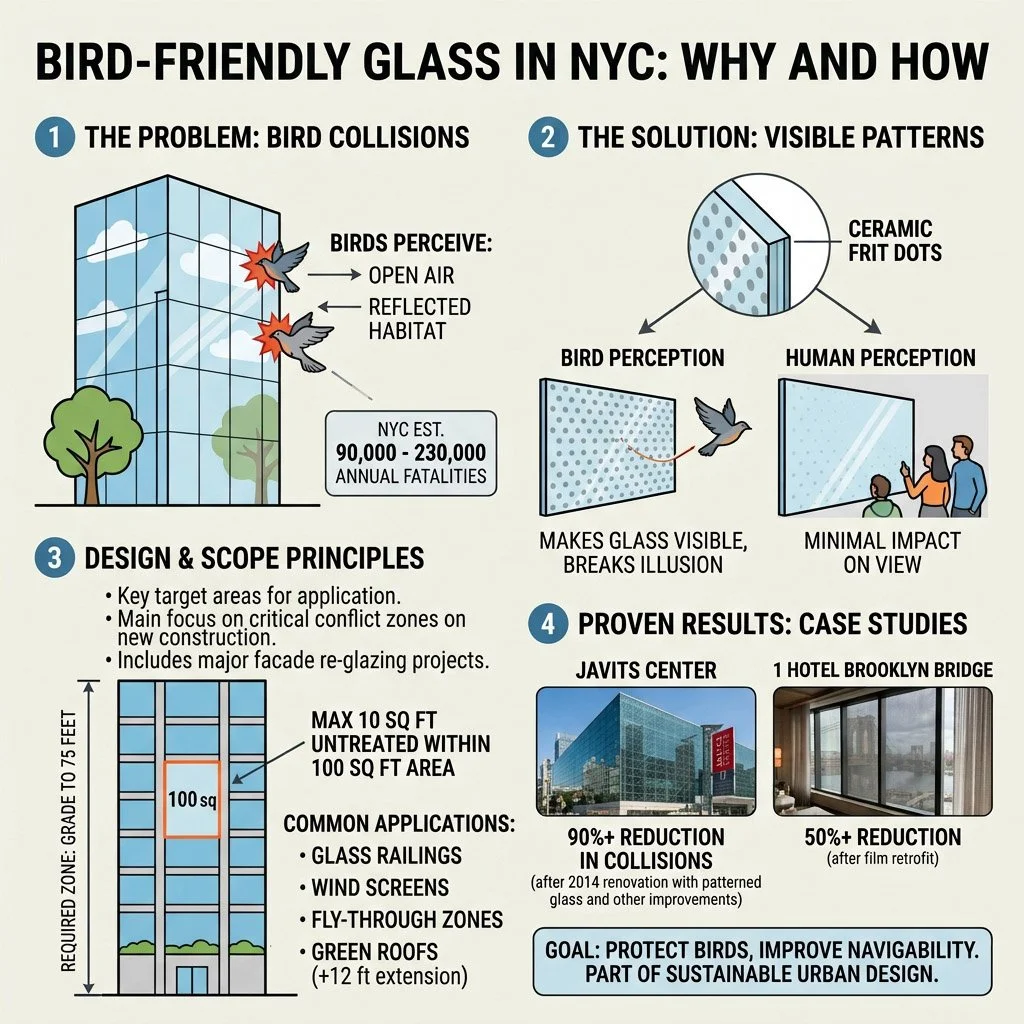
Birds do not perceive glass the way people do. A clear pane with sky or trees behind it can look like open air. Reflective glass can mirror vegetation or clouds and appear to offer a safe flight path. The result is a collision with a solid surface the bird may not recognize until it is too late. At flight speed, those collisions can cause serious or fatal injuries, sometimes immediately and sometimes after the bird initially flies away. The scale is significant. NYC Bird Alliance estimates that roughly 90,000 to 230,000 birds die each year from building collisions in New York City. The city also sits along the Atlantic Flyway, one of North America's major migration routes, which means huge numbers of birds pass through the region during spring and fall migration.
What the Dots Actually Do
The pattern is often a ceramic frit permanently applied to the glass, although films and other bird-friendly materials can also be used. The purpose is to interrupt the illusion created by clear or reflective glazing. A sufficiently visible pattern helps a bird recognize the glass as a physical barrier rather than open sky, vegetation, or a reflected landscape. In some cases, the treatment also reduces reflections that can contribute to collisions. Bird-friendly materials are evaluated using a metric known as a Threat Factor, developed through testing associated with the American Bird Conservancy. Under the New York City Building Code, qualifying bird-friendly material generally must have a Threat Factor of 25 or less. The number represents the percentage of tested birds that fly toward the material, so lower is better.
The Law Behind It
The current requirement comes from Local Law 15 of 2020, which took effect on January 10, 2021. It applies to new buildings and to alterations that replace all of a building's exterior glazing. A partial storefront replacement, for example, does not automatically trigger the requirement. A new ground-up building does. For most building envelopes, bird-friendly materials are required from grade up to 75 feet, where many collisions occur. Within that zone, no more than 10 square feet of non-bird-friendly material is generally permitted within any 100-square-foot area of facade. This helps prevent bird-friendly treatment from being reduced to small, isolated patches. Additional rules apply to certain conditions, including glass railings, wind screens, acoustic barriers, fly-through conditions and glazing adjacent to green roofs. For green roofs, the requirement generally extends 12 feet above the roof surface. Where zoning or other regulations require transparent storefront glazing, the code also allows certain UV-reflective patterns designed to be more perceptible to birds while remaining comparatively unobtrusive to people.
Bird-friendly film retrofit applied to existing building glass
The Building That Helped Prove It Works
One of the strongest examples in New York is the Javits Center.
The original building, designed by I.M. Pei & Partners with James Ingo Freed as lead designer, opened in the 1980s with a large dark glass envelope. It later became known as one of the city's most problematic buildings for bird collisions. During the major renovation completed in 2014, roughly one-third of the glass was replaced with stainless steel panels, while much of the remaining glazing was replaced with lower-reflection fritted glass. After the renovation, bird collisions dropped by more than 90 percent. The project also added a 6.75-acre green roof and significantly improved the building's environmental performance. Javits reports that the broader renovation reduced annual energy consumption by about 26 percent. It is important not to draw the wrong conclusion from that number. Bird-safe glass does not automatically make a building energy efficient, and energy-efficient glass is not automatically bird-safe. But the Javits project shows that the two objectives can be addressed together through careful facade design, better glazing, improved envelope performance and broader building-system upgrades.
Why It Matters for How We Design
Most conversations about sustainable architecture focus on carbon, energy use and operational performance. Bird-safe design introduces another question: what does the building do to the living systems around it? A glass facade is not only an energy problem or an aesthetic decision. It is also a physical object that wildlife must be able to navigate. In New York, bird-friendly design is now part of the code for new construction and qualifying glazing replacements. Existing buildings can also be improved through relatively straightforward interventions, including patterned films applied to existing glass. At 1 Hotel Brooklyn Bridge, for example, a bird-friendly film retrofit contributed to a recorded reduction in bird collisions of more than 50 percent in the treated area. The dots are not decoration, and they are not simply a visual trend. They are a small but increasingly important sign that a building has been designed with something beyond the people inside it in mind.
Frequently Asked Questions
Are the dots on building glass required by law in NYC? Yes. Local Law 15 of 2020 requires bird-friendly materials on most new buildings and on alterations that replace all of a building's exterior glazing, effective January 10, 2021.
Do bird-friendly windows block the view from inside? No, not meaningfully. The patterns are designed to be visible to birds while staying subtle from the interior. Where clear storefront glazing is required, the code allows UV-reflective patterns that birds perceive but people barely notice.
What triggers the bird-friendly glass requirement? New construction and full replacement of a building's exterior glazing. A partial storefront replacement generally does not trigger it, but a ground-up building or a complete re-glazing does.
How high up does the requirement apply? For most facades, bird-friendly materials are required from grade up to 75 feet, the zone where most collisions occur. Near green roofs, it generally extends 12 feet above the roof surface.
Can existing buildings be made bird-safe? Yes. Bird-friendly films can be applied to existing glass. At 1 Hotel Brooklyn Bridge, this kind of retrofit cut collisions by more than 50 percent in the treated area.
Birds do not perceive glass the way people do.