
The US Open Is Being Played Inside a Working Construction Site
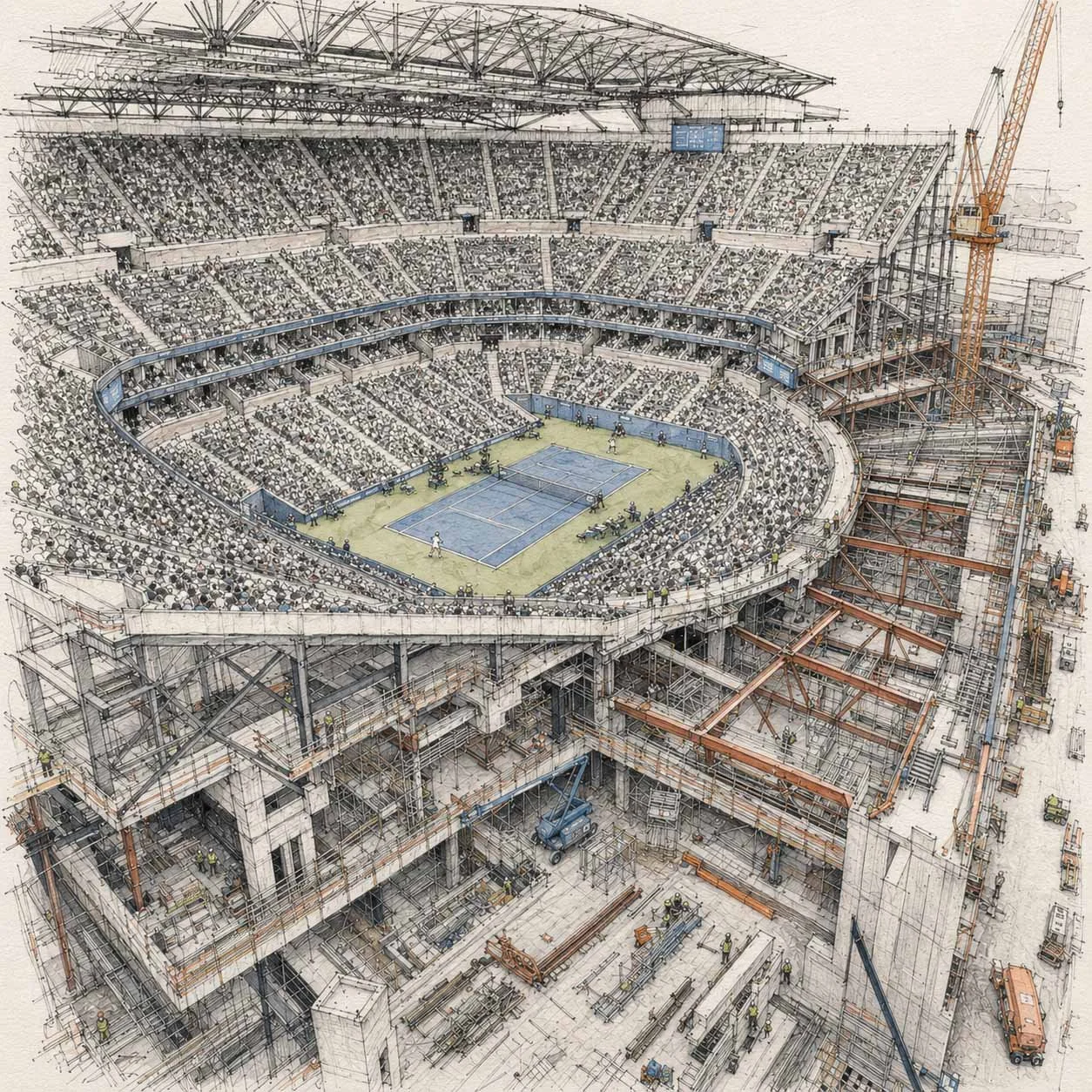
Arthur Ashe Stadium in Flushing Meadows is the largest tennis stadium in the world. With just under 24,000 seats, it has been home to the US Open and the anchor of professional tennis in North America since opening in 1997. And right now, it also happens to be a construction site.
The USTA and its project team are pushing through an $800 million overhaul of the campus, split across three phases, none of which is allowed to interrupt the tournament. The finish line is set for before the 2027 US Open. That means both the 2025 and 2026 editions are being played in the middle of an active renovation.
Here is the catch: during the championship itself, the stadium has to look finished. Not a trace of construction can remain visible. And that is not simply a preference. It is built into the project requirements.
What They're Actually Building
The point is not to add more seats. Instead, the renovation pulls roughly 2,000 seats closer to the court, reconfigures the lower bowl, and adds nine courtside clubs, two full suite levels, and a promenade concourse that grows by approximately 40 percent.
The work is divided into three stages. Phase 1 wrapped in 2025 and focused on the structural reinforcement needed to support everything that follows. Phase 2, underway now, rebuilds portions of the courtside bowl and suite levels. Phase 3 brings the reworked concourses, improved movement between levels, and new hospitality spaces, all scheduled for completion before the 2027 tournament.
On the west side of the campus, beside the practice courts, a new two-story Player Performance Center is also taking shape.
The Engineering Headache
The fundamental constraint is simple: the US Open cannot move somewhere else while the work happens. Arthur Ashe Stadium is the only venue in the complex capable of hosting the tournament at this scale, which makes every annual deadline effectively immovable.
To keep pace, WSP integrated steel connection design and detailing into the broader design process, helping compress the construction schedule by several months.
Every phase has to be completed, inspected, and concealed before tournament play begins. Hoarding comes down. Scaffolding disappears. For several weeks, the stadium has to operate as though the construction site does not exist. Then, immediately after the tournament ends, work starts again.
The architecture firm Rossetti has described the process as a form of major surgery on the existing stadium, with significant portions of the interior structure being removed and rebuilt while the overall venue remains intact.
The Sustainability Case
The clearest environmental argument is also the simplest: the USTA chose to renovate rather than demolish the stadium and start again. That decision preserves much of the carbon already embodied in the building's existing concrete and steel while avoiding the enormous quantity of demolition waste that a complete replacement would create. Environmental controls also extend to the construction process itself. Concrete washout containment systems capture slurry and wash water so it can be collected, treated, and recycled rather than entering the surrounding site or drainage system.
The retractable roof added in 2016 follows a similar logic. Its lightweight, self-supporting structure was designed to span above the existing stadium rather than rely heavily on the original structure below. It reduced weather-related interruptions while allowing the stadium to continue functioning in increasingly unpredictable late-summer conditions.
It is a useful example of climate adaptation being layered onto an existing building rather than requiring its replacement.
Why This Matters Past the Tennis
Renovating a building while it remains in use is among the most difficult forms of construction. It requires phasing, coordination, temporary systems, and deadlines that would not exist on an empty site.
But it can also preserve enormous amounts of existing material, infrastructure, and embodied carbon.
New York is full of major public buildings reaching the point where substantial reinvestment is unavoidable. The Arthur Ashe project shows what repairing and transforming a building in place can look like when planning, engineering, and construction sequencing are treated as fundamental parts of the design.
Nobody would call it the easy route. But in many of the ways that matter most, it may be the smarter one.
The 2026 US Open runs from August 23 through September 13, with the main draw beginning August 30. Construction resumes immediately after the tournament.
The team treated environmental care as a core priority rather than an afterthought. On site, concrete washout containment systems caught the slurry and washout water so it could be collected, treated, and recycled, in line with EPA rules and local requirements.