
A Structure That Grows
What the New York Botanical Garden Just Installed Under Its Historic Glass Dome
The Enid A. Haupt Conservatory at the New York Botanical Garden is one of New York City’s great glasshouses. Completed in 1902, its soaring glass-and-steel structure has housed tropical rainforests, desert ecosystems, palms, and other living collections for more than a century.
This summer, something experimental is growing inside it.
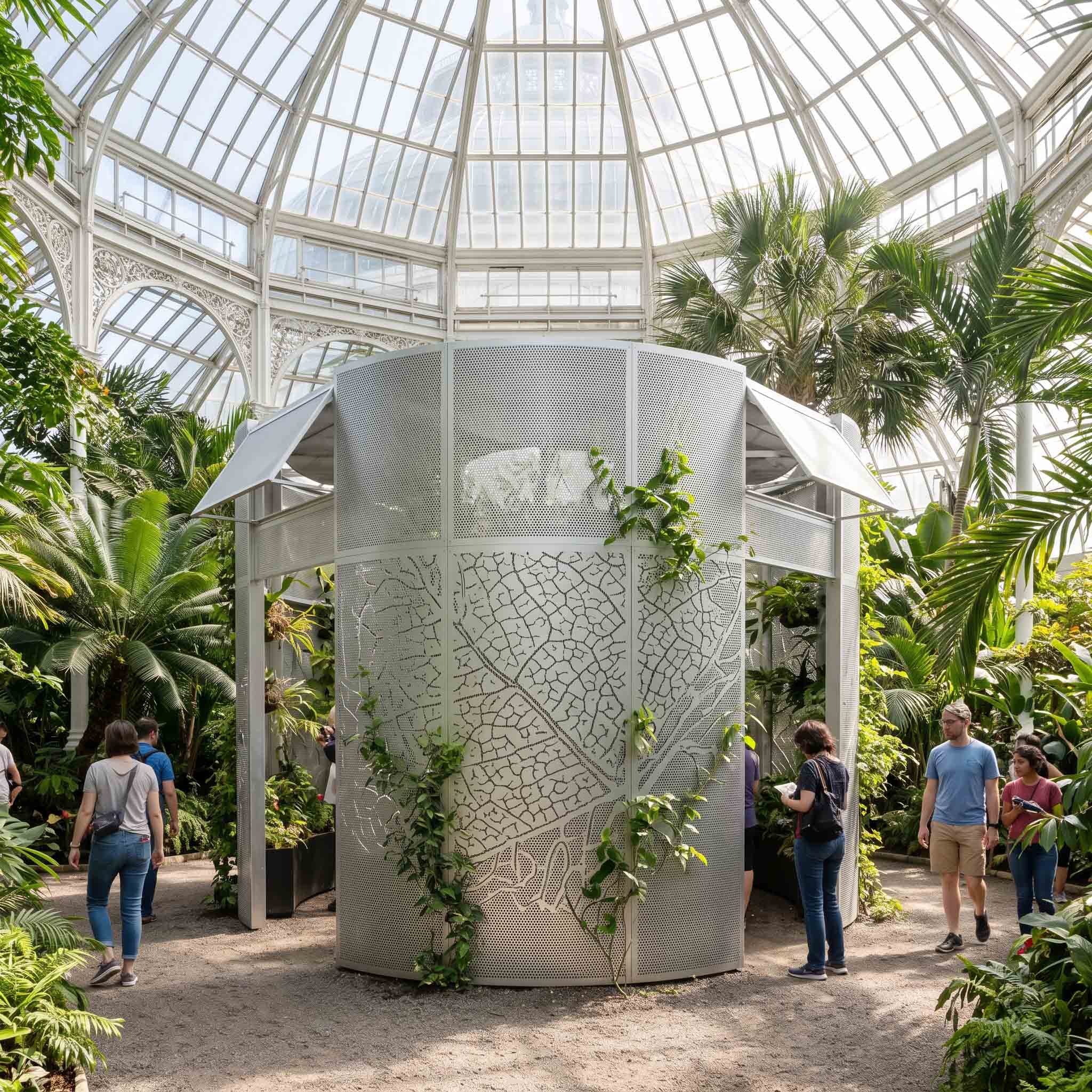
Greenhouse Prototype 2 is an interdisciplinary installation by architectural designers Hermine Demaël and Stephen Zimmerer, developed with Dr. Evelyn Beaury, Assistant Curator at the New York Botanical Garden’s Center for Conservation and Restoration Ecology. The project brings architecture and botanical research together in a lightweight, mobile structure designed to create a localized microclimate for plants and people.
The installation is on view through October 5, 2026.
A Different Kind of Greenhouse
Greenhouse Prototype 2 uses perforated aluminum panels curved along a ten-foot radius, referencing the geometry of the Haupt Conservatory’s historic glass roof. Vegetation is intended to gradually grow across the lightweight surfaces, allowing the structure to become increasingly integrated with its surroundings.
Rather than creating a completely sealed environment, the prototype uses shading, passive airflow, and misting to regulate temperature and humidity while remaining open to the larger conservatory.
That distinction is central to the experiment. Instead of isolating plants from their surroundings, the structure creates a smaller zone of modified environmental conditions within an existing ecosystem.
Its aluminum panels also carry scientific information. A large-scale research drawing developed by Demaël and Zimmerer with scientists at NYBG abstracts microscopic leaf-vein structures, the networks plants use to transport water and resources. Dr. Douglas Daly, NYBG curator and specialist in Amazonian botany, was part of the project’s design team.
Architecture becomes both environmental infrastructure and a surface for communicating botanical research.
Reuse as a Design Strategy
The structure also has a previous life.
Its aluminum frame was recycled and reconfigured from a greenhouse exhibited at Syracuse University’s School of Architecture in 2025. Instead of treating reuse as a limitation, the project makes an existing structure the starting point for another architectural experiment.
That approach matters. Reusing structural components reduces the demand for new material while forcing designers to work creatively with what already exists.
From Enclosure to Habitat
The larger question behind Greenhouse Prototype 2 is how greenhouses might evolve as environmental conditions change.
Traditional greenhouses generally depend on maintaining a controlled distinction between interior and exterior climates. This prototype explores something more permeable: a structure that modifies local conditions without completely separating itself from its environment.
The designers describe the possibility of greenhouse structures becoming habitat refuges, supporting species as temperatures, rainfall patterns, and ecological ranges shift.
That makes the installation more than an object inside a botanical garden. It is a small-scale test of how architecture might respond to environmental change through adaptation rather than complete climatic isolation.
Why It Matters Beyond the Garden
The experiment also touches on questions facing architecture more broadly.
How can buildings create comfortable environments with less dependence on energy-intensive mechanical conditioning? How can existing materials be reused rather than discarded? And how can architecture work with changing environmental conditions instead of simply attempting to exclude them?
Greenhouse Prototype 2 does not claim to solve these problems at building scale. It is a prototype, and its value lies precisely in testing ideas at a scale where they can be observed, adjusted, and questioned.
Inside one of New York’s most historic controlled environments, a small experimental structure is testing a different relationship between architecture and nature: lighter, more permeable, reusable, and designed to change as the living systems around it change.
Greenhouse Prototype 2 is on view at the Enid A.
Haupt Conservatory at the New York Botanical Garden through October 5, 2026.
How can buildings create comfortable environments with less dependence on energy-intensive mechanical conditioning?