
The Bar That Serves the Whole Night
Designing hospitality for the way people actually drink now
There is a headline that gets recycled every few months: young people are drinking less, and the bar is in trouble. The first half is true. The second half is wrong, and the reason it is wrong is useful if you are designing a place where people gather.
Here is what the data actually shows. Gen Z drinks roughly 20 percent less alcohol per person than millennials did at the same age, and nearly half say cutting back matters to them. But the same generation has not stopped going out. What they have done is change the shape of a night. Around three quarters of them now alternate between an alcoholic drink and a non-alcoholic one over the course of an evening, a habit the industry has started calling "zebra striping." The motivation is not abstinence. It is stamina. They want to stay at the party longer without paying for it the next morning.
Read that again, because it reframes the whole design brief. The person ordering a mezcal cocktail at nine and a good alcohol-free spritz at ten is not two customers. It is one customer, and a bar built for only half of that night loses the other half. The opportunity is not to pick a side. It is to serve the entire evening for the same person.
The bar has to be worth the trip
There is a second number worth sitting with. A growing share of young drinkers now do most of their drinking at home. Bar and club visits have dropped sharply as a result. That sounds like bad news until you look at what it actually means. When staying in is easy and cheap, the bar stops competing on the drink and starts competing on the room. Nobody leaves the apartment for a beer they could have had on the couch. They leave for the place.
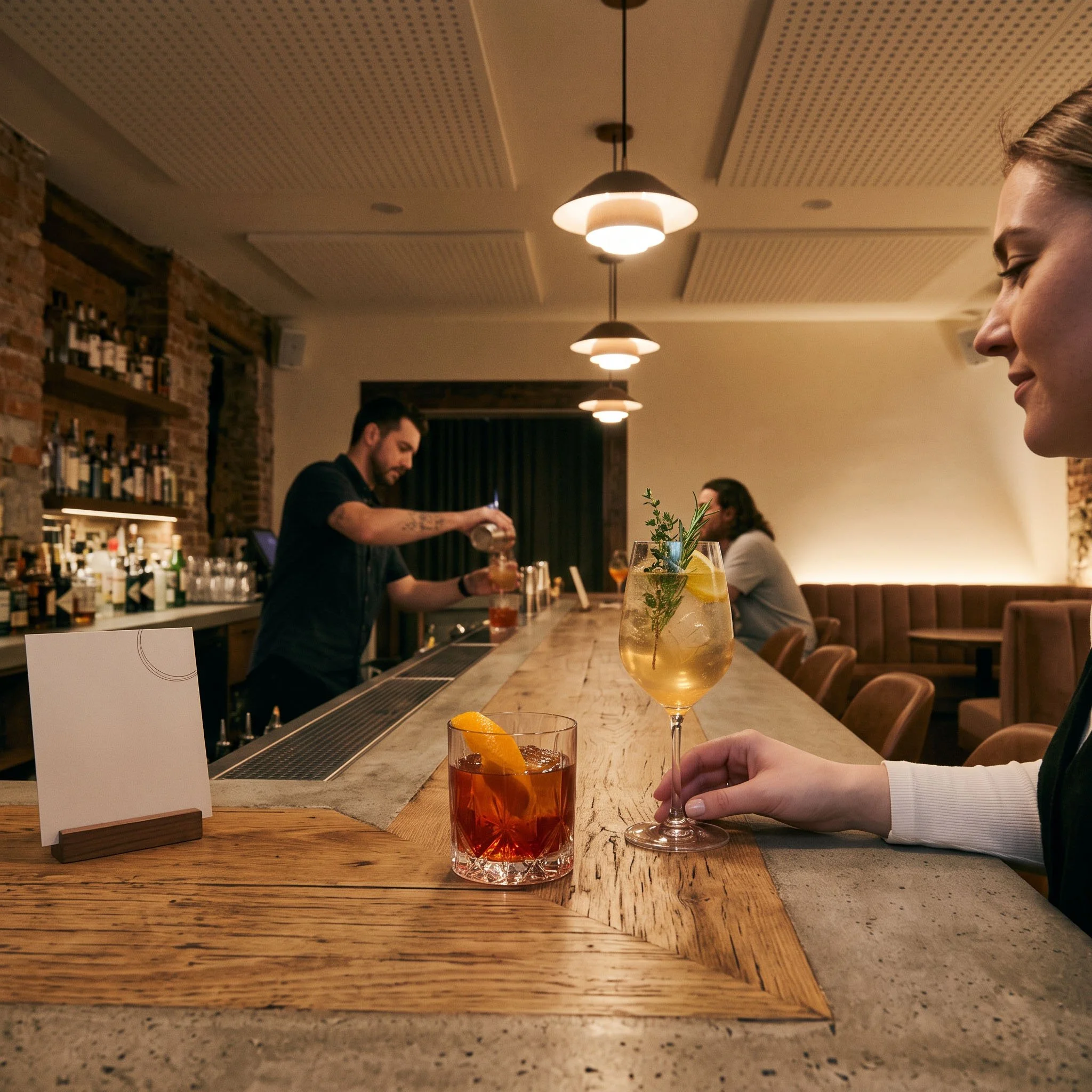
This is where the conversation moves out of the beverage director's hands and into the architect's. If the drink is no longer the sole reason to come, then lighting, sound, seating, and the feel of the space are not garnish. They are the product. A well-designed bar has always known this. The difference now is that the margin for a boring room has disappeared.
What anchors a bar when the drink is not the only draw
A few things do a disproportionate amount of work.
Light does most of it. People stay where they look good and feel unobserved at the same time, which is a specific and achievable lighting condition: warm, low, layered, and pointed at faces rather than at the ceiling. Get this wrong and no cocktail list will save the evening.
Sound is the quiet make-or-break. A room that forces people to shout empties out early. Soft surfaces, considered ceiling treatments, and materials that absorb rather than bounce are the difference between a bar people leave after one round and one where they lose track of time. Acoustics are not a luxury line item. They are the thing that lets a conversation, and a tab, keep going.
The bar itself should read as the stage it is. Whether the bartender is building a Negroni or a zero-proof drink with the same care, the back bar is the room's focal point, and it deserves the materials, the height, and the sightlines of a focal point.
And the non-alcoholic side deserves real estate, not an apology. When the alcohol-free options get the same glassware, the same garnish, and the same visible craft as everything else, the room quietly tells every guest they belong there. That is a design decision as much as a menu one, and it costs almost nothing to get right.
None of this asks a bar to stop serving alcohol. A serious cocktail program and a serious non-alcoholic program are not rivals. They are two halves of the same night, and the best rooms make both feel like the main event.
The sustainable version lasts
There is a version of hospitality design built to be photographed once and replaced in two years. It is expensive, wasteful, and increasingly out of step with how people actually choose where to go. The more durable idea, in both senses, is to build a room that earns a long life.
That starts with reuse. Some of the best bars in New York are second and third acts inside older buildings, where the existing structure, brick, and bones do more for the atmosphere than any new finish could. Working with what is already there is the lowest-carbon move available, and it usually produces a better room than a gut renovation would.
It continues with materials chosen for age rather than novelty. Surfaces that look better worn, fixtures that can be repaired instead of tossed, and a palette that will not read as dated the moment the trend moves on. A space designed for longevity is a space you are not rebuilding, and the greenest project is the one you do not have to do twice.
The takeaway
The shift in how people drink is not a threat to the bar. It is a clearer brief. Design for one person's whole evening, make the room worth leaving home for, give the alcohol-free options the same respect as everything else, and build it to last. Do that, and you have a place that works for the guest who orders three cocktails, the guest who orders none, and the far larger group in the middle who will happily do both before the night is over.
That is the kind of space we like to design. If you are opening a bar, a restaurant with a serious drinks program, or a hotel where the bar is meant to carry the room, we would be glad to talk about how the space itself can do more of the work.
The shift in how people drink is not a threat to the bar. It is a clearer brief. Design for one person's whole evening, make the room worth leaving home for, give the alcohol-free options the same respect as everything else, and build it to last.