
Bringing Tibbetts Brook Back to Light
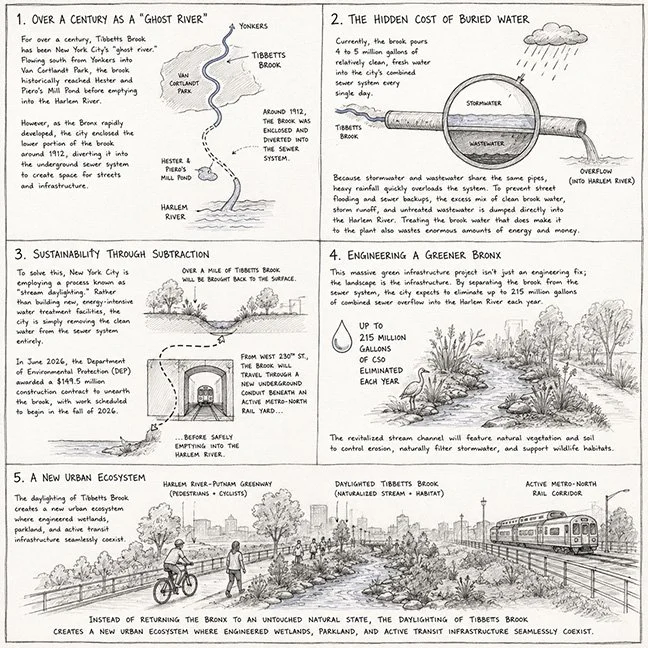
For over a century, Tibbetts Brook has been New York City’s “ghost river.” Flowing south from Yonkers into Van Cortlandt Park, the brook historically reached Hester and Piero’s Mill Pond before emptying into the Harlem River. However, as the Bronx rapidly developed, the city enclosed the lower portion of the brook around 1912, diverting it into the underground sewer system to create space for streets and infrastructure.
The Hidden Cost of Buried Water
Currently, the brook pours 4 to 5 million gallons of relatively clean, fresh water into the city’s combined sewer system every single day. Because stormwater and wastewater share the same pipes, heavy rainfall quickly overloads the system. To prevent street flooding and sewer backups, the excess mix of clean brook water, storm runoff, and untreated wastewater is dumped directly into the Harlem River. Treating the brook water that does make it to the plant also wastes enormous amounts of energy and money.
Sustainability Through Subtraction
To solve this, New York City is employing a process known as "stream daylighting." Rather than building new, energy-intensive water treatment facilities, the city is simply removing the clean water from the sewer system entirely.
In June 2026, the Department of Environmental Protection (DEP) awarded a $149.5 million construction contract to unearth the brook, with work scheduled to begin in the fall of 2026. Over a mile of the stream will be brought back to the surface, running along an abandoned CSX freight-rail corridor between Van Cortlandt Park and West 230th Street. From there, it will travel through a newly built underground conduit beneath an active Metro-North rail yard before safely emptying into the Harlem River.
Engineering a Greener Bronx
This massive green infrastructure project isn't just an engineering fix; the landscape is the infrastructure. By separating the brook from the sewer system, the city expects to eliminate up to 215 million gallons of combined sewer overflow into the Harlem River each year.
Additionally, the daylighting project will create significant new public spaces for the community. The revitalized stream channel will feature natural vegetation and soil to control erosion, naturally filter stormwater, and support wildlife habitats. Running alongside it will be a mile-long extension of the Harlem River-Putnam Greenway, transforming a former industrial corridor into a continuous, scenic route for pedestrians and cyclists. Instead of returning the Bronx to an untouched natural state, the daylighting of Tibbetts Brook creates a new urban ecosystem where engineered wetlands, parkland, and active transit infrastructure seamlessly coexist.
This massive green infrastructure project isn't just an engineering fix; the landscape is the infrastructure.