
The Bathhouse Boom Runs on Old Factories
A few months back we wrote that young people are drinking less, and that the bar, contrary to the headlines, is not in trouble. That is still true. But it leaves out something happening alongside it. A growing number of those same people are also booking a sauna. The social bathhouse has become one of the fastest-moving categories in the city. Not the quiet, robe-and-cucumber spa, but a loud, communal, sometimes theatrical version of it built around contrast therapy: sit in a hot sauna, drop into a cold plunge, repeat, then sit around and talk to strangers. Some venues run guided group sessions with breathwork and towel-waving, closer to a class than a soak. One of the more prominent operators has been described, not unfairly, as part nightclub, part cult, part group therapy. The point is that people are showing up to sweat together on a Friday night the way they used to show up to a bar. That is a cultural story, and plenty of people are telling it. The part that interests us is quieter and sits underneath the towels: almost none of these places are new buildings. They keep moving into old industrial ones.
Why the old factory keeps winning
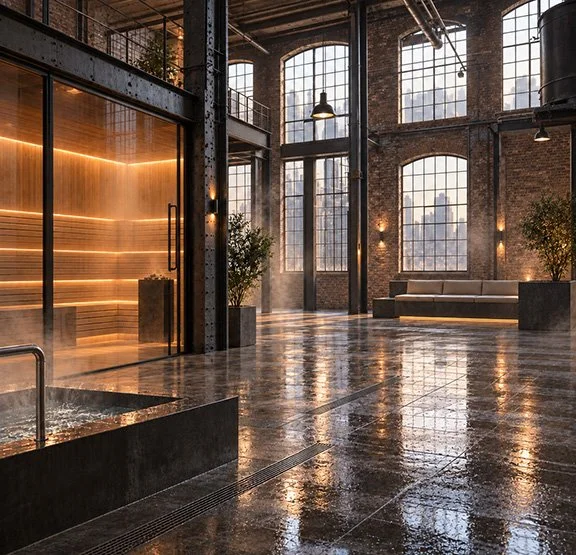
Look at where the serious bathhouses land and a pattern shows up fast. A converted soda factory in Williamsburg. An 1883 textile factory in Tribeca. Former warehouses, garages, and manufacturing floors across Brooklyn and Queens. This is not nostalgia or set dressing. It is a building decision, and it is worth understanding as one. A social bathhouse is a hard program to house. It is wet everywhere, it is heavy, and it swings between extreme heat and extreme cold in adjacent rooms. That combination punishes a cheap building. What an old industrial structure already offers is exactly what that program needs: thick masonry walls that hold temperature and block sound, floor slabs poured to carry machinery that now carry pools of water instead, high open volumes that let you stack heat and steam without feeling trapped, and drainage and utility runs sized for a use that was never delicate. You are inheriting structure that was overbuilt for industry and repurposing it for a program that also happens to be demanding. There is a softer reason too, and any honest operator will admit it. A century-old brick room reads as a sanctuary in a way a new white box never will. The patina is not a design flourish you have to add. It came with the lease.
The sustainability math, including the part nobody advertises
For a sustainability blog, the easy version of this story is: reuse good, demolition bad. That version is mostly right. The greenest building is usually the one already standing. Keeping an existing structure avoids the embodied carbon buried in its concrete, brick, and steel, and avoids the new carbon you would spend tearing it down and starting over. When a wet, heavy, mechanically intense program can slot into bones that already exist, the reuse is the biggest environmental win on the table, full stop. But we would be doing our readers a disservice if we stopped there, because a bathhouse is also an energy and water hog. Heating large saunas and chilling plunge pools at the same time, in the same building, all day, is genuinely resource-intensive. That is the tension at the center of the trend. The building shell can be a model of reuse while the operation quietly runs up a heavy bill, both in dollars and in carbon. Which means the sustainability question is not really "did they reuse the building." The good ones did. The real question is what happens after the doors open: whether the heat rejected by the cold plunges gets recovered to help warm the water elsewhere, whether the pools recirculate and filter instead of drain and refill, whether the sauna heat is managed rather than dumped. The reuse is the headline. The operations are where a genuinely sustainable bathhouse separates itself from one that merely looks like the part.
What it means for how we build social space
Strip away the branding and the bathhouse is chasing the same thing a good bar always has. It sells you a reason to leave the apartment, a ritual to organize the evening around, and a room full of other people. The drink, or the plunge, was never really the product. Belonging was. For anyone who designs spaces, that is the useful takeaway. The next generation of gathering places is being programmed around a state change as much as a drink, and it is being built by adapting the industrial buildings a previous economy left behind. That is a good problem to have. It rewards operators who understand that an old factory is not a constraint to overcome but the most valuable thing in the room, and it rewards designers who can make a hundred-year-old shell hold water, heat, and a crowd without erasing what made it worth keeping. The bar isn't going anywhere. But if you want to know what the room next to it looks like, go find the oldest building on the block and check whether the windows are fogged up.
Bird-friendly film retrofit applied to existing building glass