
The Revolving Door: The Unsung Hero of Energy Efficiency
For many of us, entering a modern office building involves a brief, daily struggle with a revolving door. These heavy, rotating glass barriers often feel like a minor inconvenience an obstacle that slows our pace or feels awkward to navigate while juggling a phone and a morning coffee.
However, the revolving door is not designed to slow people down. The building feature represents an efficient, energy-saving system that architects use to create low-energy buildings in contemporary architectural design. It functions as a mechanical airlock that keeps the outdoors out and the indoors in.
A 19th-Century Solution to a Modern Problem
The revolving door functions as a standard element of contemporary commercial buildings, although it originated during the Victorian era in Philadelphia and New York City.
Theophilus Van Kannel patented his invention in 1888. He chose to name it differently from what others referred to as a “revolving door.” The patent document presented a “Storm-Door Structure” that functioned to protect against wind, snow, and street noise while enabling people to enter and exit at the same time.
The world’s first installation was not in a bank or a government building, but at Rector’s, a luxury restaurant in Times Square, in 1899. Van Kannel presented his invention to the public as a solution that would block both “noxious effluvia” and “baleful miasmas” from entering the building. His medical terminology contained exaggerated language, but his engineering approach proved to be correct. He had inadvertently created the perfect solution for the skyscraper age.
The Physics of the “Stack Effect”
The fundamental design of Van Kannel’s invention becomes clear through the analysis of skyscrapers, which effectively operate as ventilation systems.
The stack effect causes warm indoor air to rise through buildings during winter months. As that warm air moves toward the roof, it creates a powerful vacuum at ground level that attempts to pull cold air in from the street.
People who have tried to open a typical swinging door in a lobby entrance have likely experienced this force. The effort required to open the door increases as users resist the strong pull created by the building’s internal air pressure.
Always Open, Always Closed
The revolving door operates through a fundamental contradiction: it allows people to enter and exit while preventing outside air and water from entering the building.
A standard swinging door creates an unobstructed air exchange tunnel when it is opened. One study from MIT estimates that a single person entering a building through a swinging door allows roughly eight times more air to escape than if that person used a revolving door.
In a busy lobby with thousands of people entering and exiting, this air exchange could result in potential thermal loss.
The Human Variable (Truth over Agreement)
The technology of the revolving door is sound, but its full potential relies on a critical variable: the user. While the system is designed to create a perfect mechanical airlock, its energy-saving capacity is only realized when utilized as the primary entrance.
When standard swinging doors are used instead, the building's thermal integrity is momentarily compromised. This creates a vital intersection in sustainable design: a building can be engineered with a high-performance, airtight façade, but that efficiency is effectively negated if the thermal seal is bypassed. This reality serves as a reminder that sustainable architecture is not just a static backdrop; it is a participatory system that depends on the active engagement of the people inside.
Conclusion
So, the next time you step into that slow-moving glass cylinder, try to see it differently. It is not just an obstacle to navigate with your morning coffee; it is a 130-year-old invisible shield that you help activate. By simply taking the spin, you are doing more than just walking inside, you are actively securing the thermal envelope and protecting the building’s energy footprint, one rotation at a time.
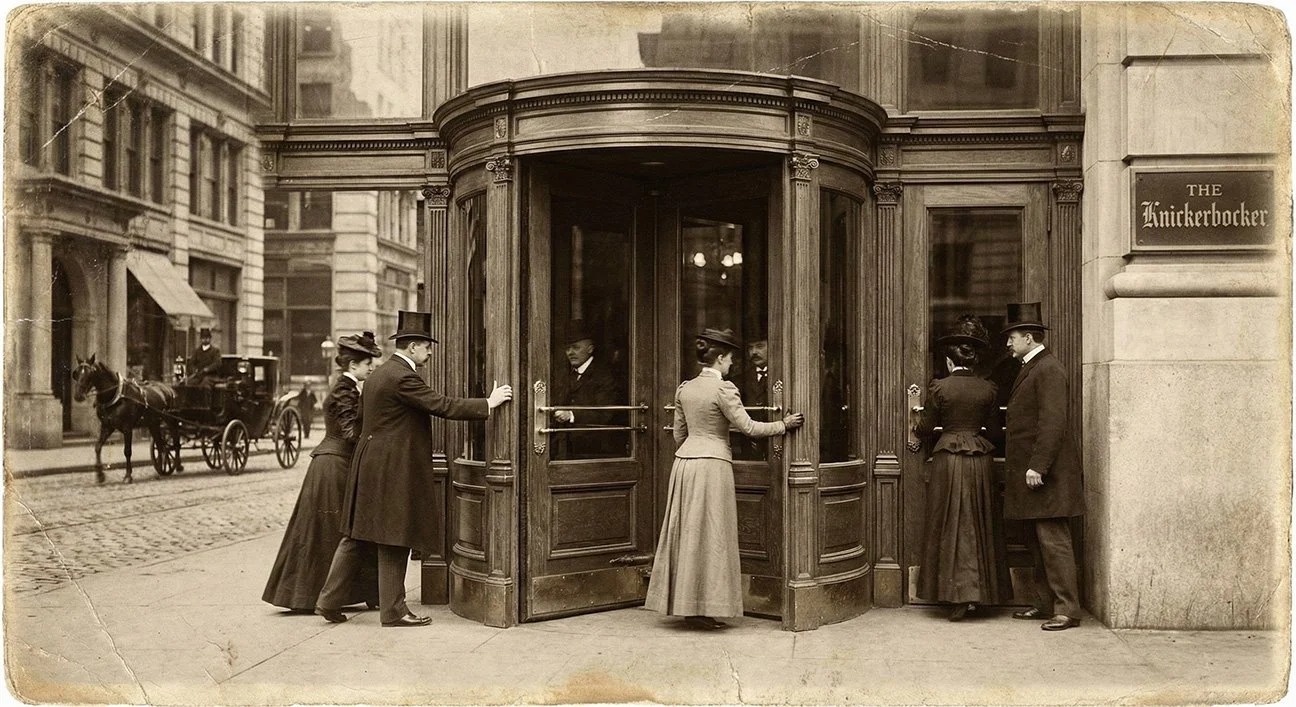
The history of the revolving door