
The Service Core: How High-Rises Move the Things Nobody Sees
There is a space in almost every mid-rise and high-rise building in New York City that residents rarely think about. It does not appear in listing photos and receives no design attention. Yet building managers and architects consider it a critical asset because it dictates daily operations.
This space is the service elevator.
It handles move-ins, carries contractors and their equipment during renovations, and moves daily deliveries, trash, and building materials. In a well-run residential building, this cab is in near-constant motion. Decisions regarding its size, capacity, and relationship to the service entrance shape the operational efficiency of the entire property.
Built for Utility, Not Appearances
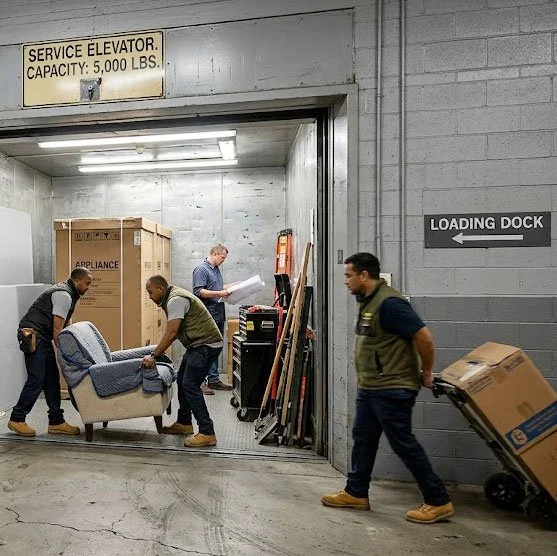
While passenger elevators prioritize speed and aesthetic finishes, service elevators are engineered for utility.
Modern service cabs typically feature ceilings ten feet or taller, with wide door openings designed to accommodate appliances and palletized deliveries. More importantly, the cab depth is specifically sized to carry standard four-by-eight-foot sheets of drywall. A standard passenger elevator typically maxes out at a capacity of 2,500 to 3,000 pounds, whereas a residential service elevator is rated for 4,000 to 5,000 pounds or more. In pre-war buildings, the infrastructure varies widely. A luxury apartment tower built on the Upper West Side in the 1920s might have a service lift that was generous for the era but may feel narrow by today’s expectations. Contractors regularly encounter cabs that cannot fit a standard refrigerator or a deep-framed sofa, turning routine deliveries into complex logistics puzzles.
A Design Principle That Goes Back Over a Century
The separation of passenger and utility movement has been central to high-density architecture since the late nineteenth century. Early skyscrapers and luxury apartment hotels in Chicago and New York treated vertical transportation as a dual system. The Woolworth Building, completed in 1913, utilized a highly advanced service core with dedicated cars sized independently from the main passenger fleet. On Park Avenue and Fifth Avenue, early twentieth-century residential towers integrated service entries, basement loading zones, and service elevators into a single coordinated system. This layout ensured that staff, ice deliveries, and maintenance work never disrupted the main passenger corridors.
The underlying principle remains unchanged: a tall building is only as functional as its vertical circulation. The architectural ambition of a facade matters little if the building cannot manage a renovation or receive daily shipments without disruption to daily operations.
More Volume, Same Single Point of Entry
New York City residential buildings are managing more logistical pressure than they were originally designed to handle. E-commerce has drastically increased daily delivery volumes. At the same time, aging infrastructure requires frequent mechanical upgrades, and apartments undergo renovations at a higher rate than in previous decades.
All of this material volume moves through a single point: the service elevator.
The properties that handle this well are those where the service core was designed with the same rigor as the public spaces. A seamless move-in or a renovation completed on schedule is usually the direct result of a properly specified service elevator. That kind of thinking does not announce itself. It just makes everything else work better.
Built for Utility, Not Appearances