
The Air Conditioned Sky: How Gilded Age Thermodynamics Invented the Rooftop Bar
The rooftop bar looks like a contemporary lifestyle trend born out of high-end real estate marketing. The reality is more functional. It was created in the late nineteenth century as a passive cooling system designed to keep New York's theater and hospitality sectors financially solvent during summer.
The Air Conditioning Crisis of 1880
Before mechanical cooling, New York summers were an existential threat to indoor entertainment. Dense brick and masonry structures absorbed heat all day. At night, hundreds of bodies combined with gaslit chandeliers turned performance halls into suffocating thermal traps. From June through September, theater owners faced financial collapse as ticket sales collapsed. The population simply refused to sit inside stagnant, unventilated rooms.
The solution was not a machine. It was a spatial reorientation designed by Rudolph Aronson, a New York composer and theater manager. After observing open-air beer gardens across Europe, Aronson realized that vertical Manhattan could replicate that environmental relief by using the forgotten real estate above the street.
The Casino Roof Garden and the First Blueprint
In 1882, Aronson opened the Casino Theatre at 39th Street and Broadway, a striking Moorish Revival structure. By the late 1880’s he had added the Casino Roof Garden, one of the earliest commercial rooftop venues in the United States.
The layout exploited basic urban thermodynamics. By elevating the patron experience several stories above the street, the venue escaped the stagnant heat island of the ground plane and caught natural cross-breezes moving across the island from the Hudson and East rivers. Early incandescent wiring replaced gas lighting to reduce heat. Potted palms and climbing ivy introduced shade and moisture through transpiration. Patrons paid a premium just to ride the elevator past the hot theater below.
The Extravagant Evolution
The profitability of the Casino Roof Garden triggered a building boom. In 1890, McKim, Mead and White completed the second Madison Square Garden on 26th Street. Stanford White designed a sophisticated rooftop garden beneath a 300-foot tower modeled after the Giralda in Seville, turning the roof into a civic landmark.
In 1900, Oscar Hammerstein I pushed further with his Paradise Roof Garden in Times Square. Built over the Victoria and Republic theaters, it featured a miniature lake with live swans, a functioning windmill, and real cows. A glass-enclosed promenade kept the bar operational during summer rainstorms, an early iteration of indoor-outdoor flexibility still standard in hospitality design today.
From Passive Cooling to Structural Identity
As HVAC systems became standard in the 1920s and 1930s, the rooftop shifted from temperature management to spatial luxury. The Rainbow Room opened on the 65th floor of 30 Rockefeller Plaza in 1934, marking the formal transition of the rooftop lounge into permanent Art Deco architecture. The space used floor-to-ceiling glass and panoramic views to celebrate verticality rather than river breezes. Its now-iconic rotating dance floor was added in later years as the venue evolved.
Modern New York hospitality continues to build on this heritage. Venues like Gallow Green on West 27th Street channel the overgrown aesthetic of Aronson's original gardens with weathered wood and vine canopies. Others use minimal concrete and stark geometry to prioritize unobstructed skyline views.
When we design rooftops today, we are participating in a tradition that started as a raw fight against urban humidity. The rooftop bar is a reminder that some of the most iconic elements of New York architecture were born when designers stopped looking for mechanical solutions and simply looked up.
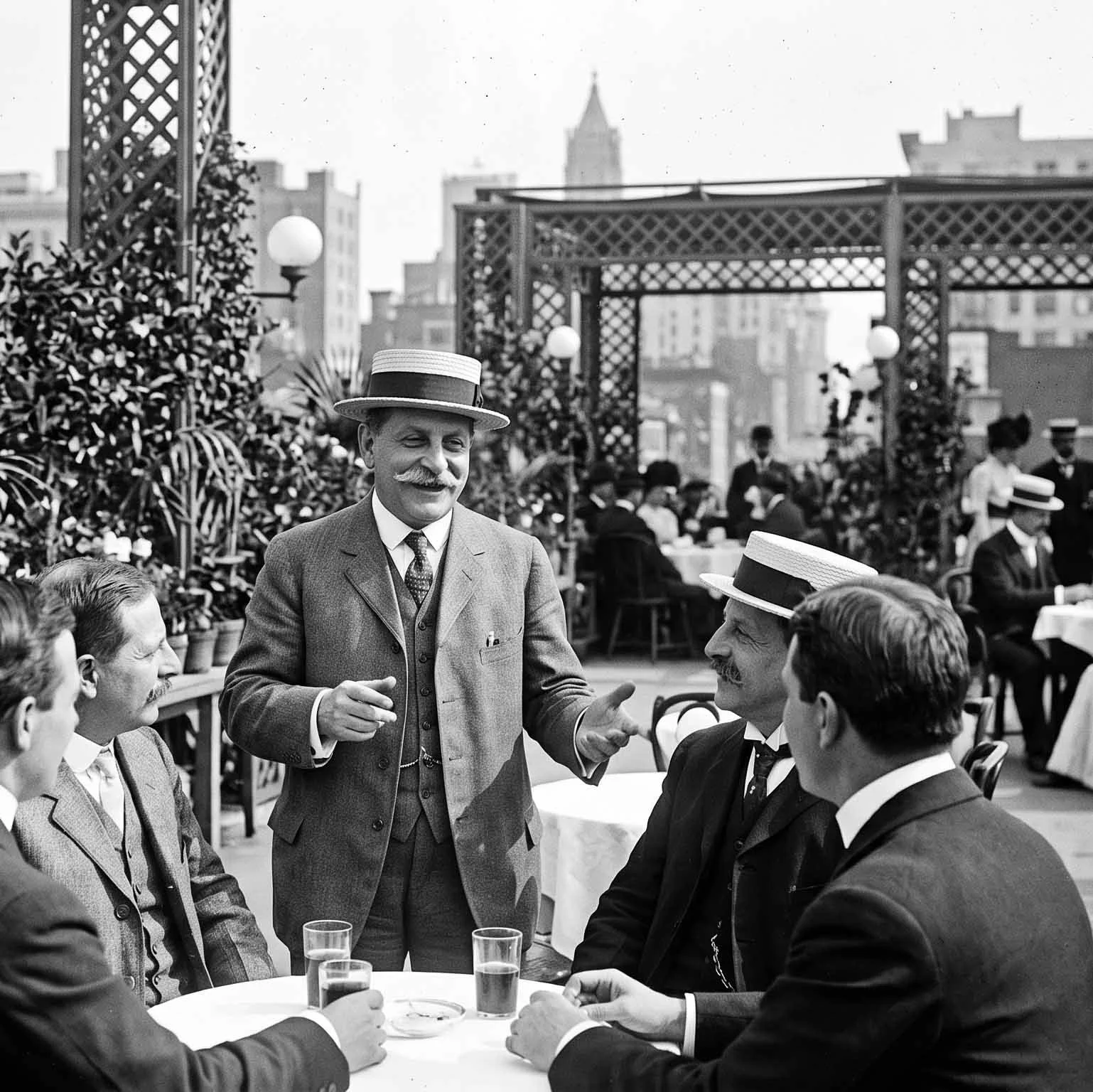
An inspired digital art rendering of Rudolph Aronson in 1900 on a rooftop with friends