
The Hollow Foundation: How New York's Skyscrapers Stand on Top of Subways
When you look at a classic Manhattan skyscraper, your brain assumes it is anchored by a massive, solid mountain of concrete and bedrock directly beneath its base. In a dense vertical city, that assumption is frequently wrong.
Dozens of New York's largest towers are structurally hollow at the ground plane. They are built directly above a vast labyrinth of active subway tunnels, commuter rail lines, and multi-level subterranean concourses. Engineering a 50-story office tower to sit safely over a literal void requires shifting the core architectural strategy from simple excavation to complex structural gymnastics.
The Air Rights Evolution of Grand Central
The blueprint for building over voids was pioneered during the reconstruction of Grand Central Terminal in the early 1900s. Chief engineer William J. Wilgus realized that the steam-to-electric train transition allowed the city to completely cover the massive, open-air rail yard north of 42nd Street.
This intervention invented the concept of commercial "air rights." Instead of digging traditional basements, developers purchased the empty space above the active tracks.
The MetLife Building (originally the Pan Am Building) is a masterclass in this technique. Built directly over the multi-tiered train platforms, its columns cannot drop straight down into a standard foundation grid. Instead, engineers mapped out the exact gaps between the active tracks. They threaded 99 steel supports through the platforms, driving them 55 feet below grade, often within inches of live infrastructure, and isolated each one with shock-absorbing pads to keep the physical rumble of the trains from traveling up into the tower.
The Stilts of Citigroup Center
As Midtown densified, towers also had to adapt to obstacles sitting on the ground plane itself, not just beneath it. The most dramatic example of this engineering friction is the Citigroup Center (601 Lexington Avenue), completed in 1977.
The developers faced a stubborn obstacle: the historic St. Peter's Evangelical Lutheran Church occupied one corner of the site and refused to move. The congregation agreed to sell only on the condition that a brand-new church be built in the exact same spot, with none of the skyscraper's structure passing through their sanctuary. With the corners of the lot effectively off-limits, a conventional column grid was impossible.
The structural response was entirely unconventional. Architect Hugh Stubbins and engineer William LeMessurier elevated the entire 59-story skyscraper on four massive nine-story stilts. Crucially, these stilts were not placed at the corners of the building, where they would have landed on the church. Instead, they were positioned at the exact midpoint of each side of the building.
The entire tower cantilevers out over these central stilts. The resulting structure was exceptionally light for its height and prone to swaying in the wind, so LeMessurier added a tuned mass damper, a 400-ton concrete block near the roof that floats on a film of oil to counteract the building's movement. It was among the first tuned mass dampers ever installed in a skyscraper, and the first designed into a tall building from the outset to solve a structural problem created by its own footprint.
The Overbuild at Hudson Yards
The modern peak of this strategy is the development of Hudson Yards on Manhattan's West Side. The entire 28-acre neighborhood is built directly over the active Long Island Rail Road storage tracks, plus the rail tunnels used by Amtrak and New Jersey Transit.
Because engineers could not shut down the rail yards to pour a traditional foundation, they constructed a massive, high-tech platform above the moving trains. The process required drilling 300 caissons, concrete-filled shafts four to five feet in diameter, precisely between the tracks and into the bedrock below. Only about 38 percent of the Eastern Rail Yard could physically accept a support, which turned the foundation layout into a three-dimensional puzzle solved between train schedules.
This platform serves as the new artificial ground plane for plazas, gardens, and streets. The skyscrapers, however, do not rest on the platform itself. Towers like 30 Hudson Yards rise from their own caisson foundations, which pass straight through the platform. The buildings' massive vertical loads are channeled horizontally through giant steel trusses before reaching the narrow caisson points that snake down between the train tracks.
Engineering the Invisible Void
Building over subways transforms architecture from a problem of mass into a problem of precision distribution. It forces us to treat the underworld of New York not as a solid obstacle, but as a dynamic, shifting landscape. The true wonder of a modern skyscraper is not how high its steel frame reaches into the clouds, but how cleverly its foundation dodges the invisible hollow spaces beneath the pavement.
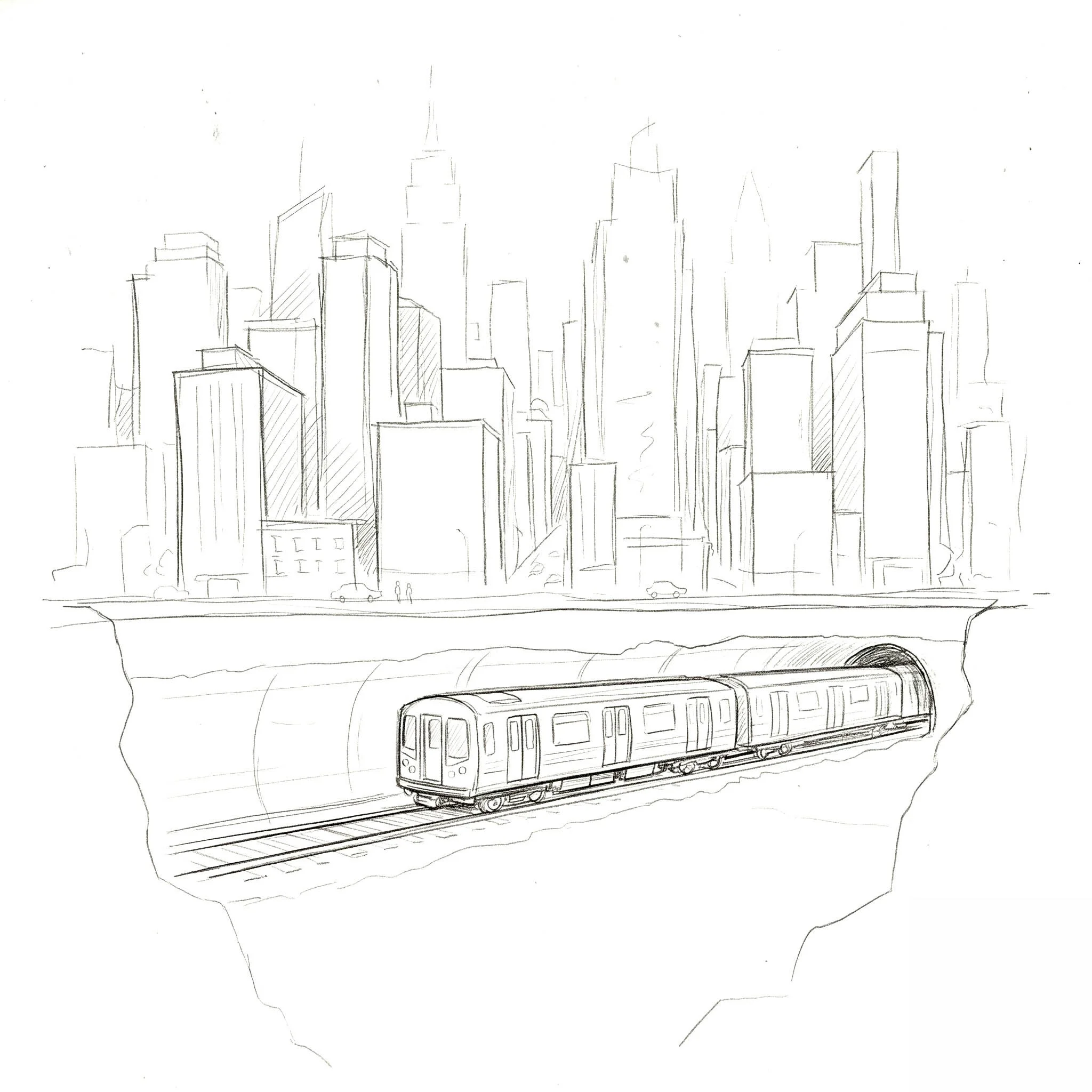
Building over subways transforms architecture from a problem of mass into a problem of precision distribution.