
The Staircase Nobody Talks About: NYC's "300,000" Fire Escapes and the Question of What Comes Next
Look at almost any pre-war building in New York City, and you will see them: iron staircases bolted to the facade, zigzagging down the front or side of the building, rusting a little, painted over too many times, occasionally holding a window AC unit or a neighbor's herb garden. Fire escapes are so common in this city that most people stopped notice them decades ago.
That is a problem, because they are aging, they cost real money to maintain, and almost nobody in the architecture or sustainability conversation is asking what happens when tens of thousands of them need to be replaced at the same time.
How They Got Here
Fire escapes became a fixture of New York City buildings after a series of fatal tenement fires in the 1860s. After the Triangle Shirtwaist Factory fire in 1911, which killed 146 workers, the rules tightened further. Buildings constructed after 1913 had to use wrought iron or steel, built to carry a live load of at least 90 pounds per square foot.
In 1968, the city stopped requiring them for new construction. Interior fire stairs, sprinkler systems, and modern fireproofing made external escapes redundant for new buildings. But the existing ones stayed, bolted to hundreds of thousands of older buildings across all five boroughs. Many of them are now more than a century old, and they are maintained, not replaced.
The Maintenance Problem
Under Local Law 11, any NYC building over six stories must have its facade, including fire escapes, inspected every five years by a licensed architect or engineer. Cycle 10 began in February 2025. Buildings are classified as Safe, SWARMP, or Unsafe. An Unsafe designation requires immediate action, including a sidewalk shed that alone can cost tens of thousands of dollars annually.
The challenge with aging iron is specific. Rust does not just sit on the surface. Once it gets into a joint or around a bolt, it expands, a process called rust jacking, which can crack or snap heavy iron components from the inside. Paint applied over existing rust traps moisture and accelerates decay. A fire escape that looks fine from the street can be structurally compromised at its anchor points in ways only a close inspection will catch.
Replacement costs for a mid-size apartment building could run approximately between $25,000 and $50,000. For landmark properties requiring Landmarks Preservation Commission approval, that number can exceed $100,000.
Where Sustainability Enters the Conversation
The default replacement material today is galvanized steel, durable and code-compliant. But there is growing interest in corrosion-resistant treatments that extend the life of existing structures rather than replacing them outright. Restoration done properly, meaning stripped to bare metal, treated for rust, and finished with quality weather-resistant coatings, can add decades to a fire escape's functional life.
From a materials standpoint, keeping a structure in service is almost always more sustainable than manufacturing a replacement. Steel production is carbon-intensive. Extending the lifespan of what already exists is the more responsible choice, and often the more cost-effective one over time.
There is also a design dimension worth noting. For buildings in historic districts, any alteration requires Landmarks Preservation Commission approval. That is often seen as an additional step, but it creates an opportunity to think carefully about what a restored or replaced fire escape actually looks like. The iron staircases on many pre-war facades are genuinely beautiful and part of what gives New York City its visual character. Replacing them without consideration for proportion and finish is a real loss.
The Bigger scheme
The answer that holds up is straightforward: treat fire escapes as the infrastructure they are. Inspect them properly and on schedule. Restore rather than patch. When replacement is necessary, specify materials and finishes that respect the building they are attached to. And factor the long-term cost of maintaining this infrastructure into building budgets now, rather than waiting for a violation to force the conversation.
Three hundred thousand fire escapes. Most of them invisible. All of them due for a closer look.
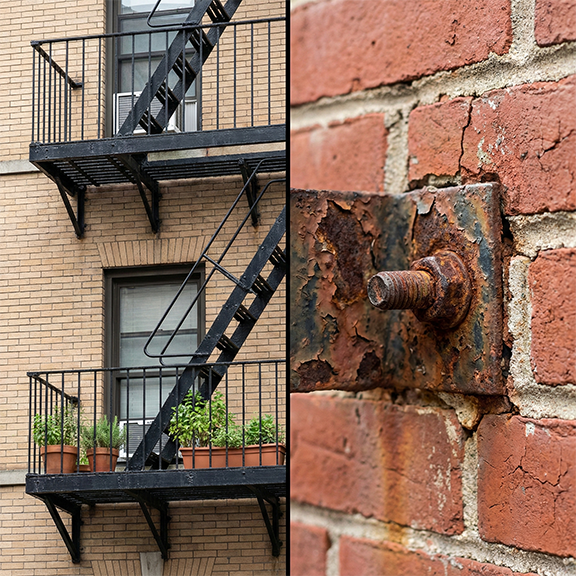
Three hundred thousand fire escapes. Most of them invisible. All of them due for a closer look.