
The Quiet Revolution: Why Cork Is the Interior Design Material of the Future
When you think of cork, you probably picture a wine bottle or a retro bulletin board. But architects and designers are taking a second look at this material, and not just for nostalgia. They are using it because it solves actual construction problems better than a lot of modern synthetic options. It handles acoustics, temperature, and air quality in a way few other materials can.
From Tree to Tile: The Carbon Story
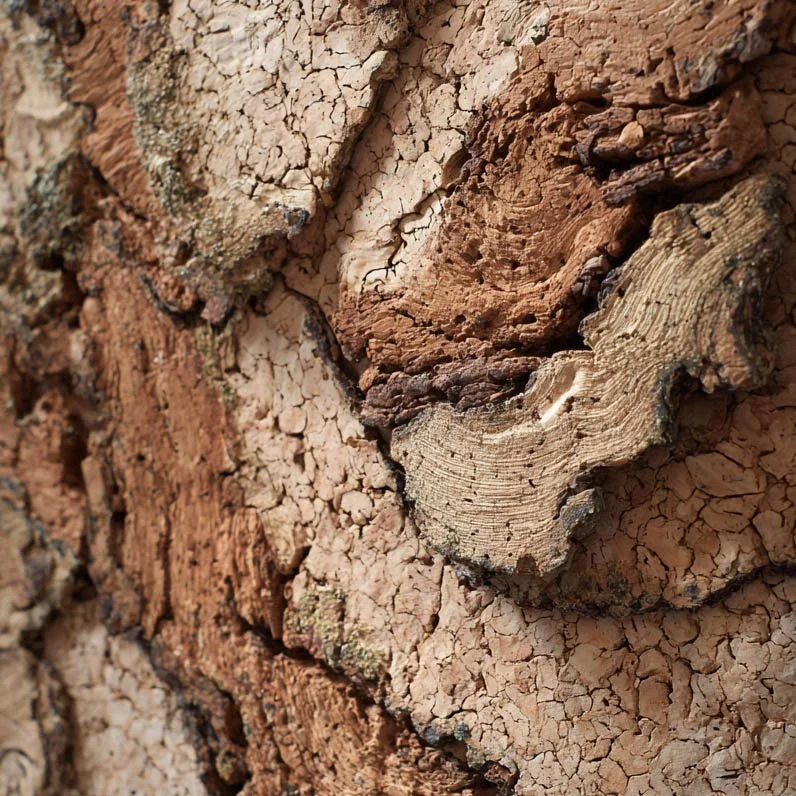
To understand why cork is valuable, you have to look at how it grows. Cork is the bark of the cork oak tree, but here is the key: you don’t cut the tree down to get it. You just strip the bark off, and it grows back every nine to twelve years.
This makes it renewable, but it is also regenerative. Harvesting the bark actually encourages the tree to absorb more CO2 to heal itself. Because the forests are kept alive and active, cork is often considered carbon negative. The trees pull more carbon out of the atmosphere than is emitted during the manufacturing process. This makes it a legitimate tool for meeting strict green building standards.
The Science of Comfort
The reason cork works so well comes down to its cellular structure. It is made of millions of microscopic honeycombs filled with air.
These air pockets act as natural shock absorbers and insulators.
Thermal Insulation: Cork floors naturally hold heat. They stop warmth from leaking into the subfloor and stop the cold from creeping up. This takes the pressure off your heating and cooling systems, which can lower utility bills.
Acoustic Control: Noise is a huge issue in open offices and city apartments. Cork absorbs sound waves rather than bouncing them around. Using cork under floors or on walls cuts down on the noise from footsteps and voices, making a space feel quieter and calmer.
Case Study: The Cork House, UK
A great example of high-performance cork design is The Cork House in Eton, UK.
This house takes the concept to the extreme. It doesn't just use cork for flooring; the walls and roof are built entirely from expanded cork blocks. These blocks act as the structure, the insulation, and the weatherproofing all in one. It was shortlisted for the prestigious RIBA Stirling Prize, proving that cork can be used to build modern, durable structures that are almost entirely carbon neutral.
Health, Durability, and Design
Cork also has a biological advantage. It contains a natural waxy substance called suberin, which repels mold, mildew, and rot. It is hypoallergenic and doesn't release those chemical smells (VOCs) you often get with new carpet or vinyl, so it keeps indoor air cleaner. There is also a myth that cork is fragile. It is actually very durable because of "elastic memory." If you put a heavy table on it, the air cells compress. When you move the table, the cells expand back to their original shape. It resists dents and provides a cushioned surface that is much easier on your back and joints than concrete or tile.
The Bottom Line
Cork isn't just a throwback material. It is a technical solution that reduces carbon emissions and makes buildings more comfortable to live in. For designers who care about how a space functions, not just how it looks, cork is one of the smartest materials available.
Cork isn't just a throwback material.