
On Thursday, November 26, the Macy's Thanksgiving Day Parade will march through Manhattan for the 100th time. The announced lineup includes 26 character balloons, five balloonicles, and 28 floats. Most people will look up at the balloons. For designers, the floats tell another story. They have to be built for Sixth Avenue and for the trip through the Lincoln Tunnel.
A design brief written by a tunnel
The floats are designed and built at Macy's Parade Studio in Moonachie, New Jersey. Some reach three and a half stories tall when assembled. To get to Manhattan, they have to clear the Lincoln Tunnel, which has 13 feet of headroom. Each float folds down to no more than about 8.5 feet wide and 12.5 feet tall, roughly the size of a city bus.
The fold is part of the design from day one. Sections have to pivot or separate without ruining the form people see on parade morning. The Tales of the Teenage Mutant Ninja Turtles float, for example, used 11 hinges to collapse for transport. Parade staff call these folding side sections outriggers.
The overnight build
Before the parade, the floats travel from New Jersey through the Lincoln Tunnel to the Upper West Side. Macy's executive producer Will Coss has noted that more than 75 units make the crossing. Once they arrive, crews use cranes to lift the pieces and put them back together on Central Park West, a job reported to take about eight to ten hours.
From an architect's point of view, this is a clear example of design for disassembly. Connections have to be accessible, components must fit through tight infrastructure, and crews need an assembly sequence that works outdoors, overnight, on a hard deadline. It is the same kind of thinking architects apply to modular buildings and interiors meant to be taken apart and reused.
A fleet built to return
Macy's typically introduces four to six new floats each year, while the rest of the fleet returns. The studio team works year-round designing, fabricating, and refurbishing floats, balloons, and costumes. Tom Turkey, which traditionally leads the procession, is the longest-running float in parade history. Rather than one-night theatrical sets, the floats work as a fleet maintained for repeat use.
That makes them a useful model for commercial interiors and temporary installations. A retail display or event structure built for multiple sites has entirely different requirements than one built only for opening night. Its parts must survive transport, fit standard storage, and make immediate sense to the crew assembling it next.
The studio's former home
The parade studio has an adaptive reuse story of its own. From 1968 until 2011, Macy's built its floats inside a former Tootsie Roll factory at 1515 Willow Avenue in Hoboken. The team eventually outgrew the space and moved to its current, larger facility in Moonachie, but the Hoboken building remains a classic example of industrial architecture finding a second life as a fabrication workshop.
What designers can learn from it
A parade float has to fold, travel, open, and return. Those constraints force designers to solve for tolerances, connections, and future assembly while they are still drawing the finished object. The same rigor applies when planning a retail fixture that moves between locations, a restaurant build-out that needs to adapt over time, or an exhibition installation meant to be stored and rebuilt. Reuse starts with how something is designed to come apart.
When the floats roll down Sixth Avenue on Thursday, every one of them will have already crossed under the Hudson folded to the size of a bus. Their smartest design feature may be the one the crowd never sees.
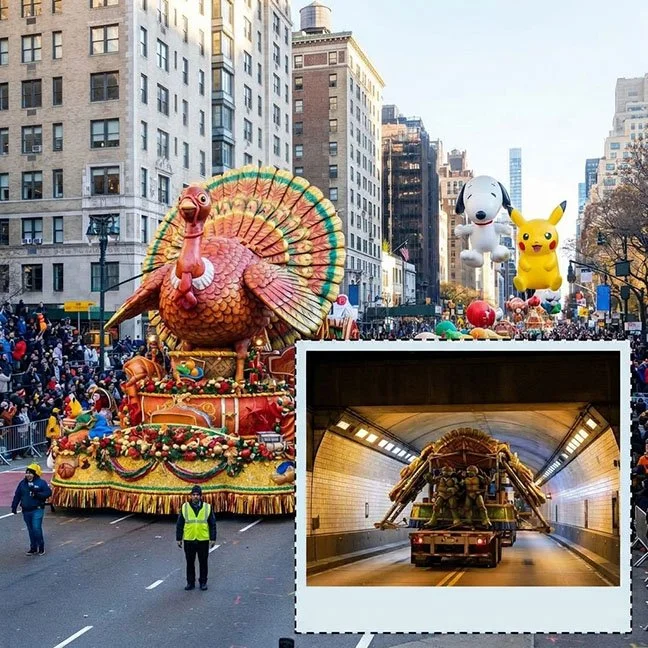
A parade float has to fold, travel, open, and return.