
Last week New York held its first Art Week. From November 11 to 14, Art Week NYC, organized by Artforum, ARTnews, and Art in America, brought over 80 galleries and 30 institutions into one program across Manhattan.
Most coverage focused on the art, but the better architectural story was where it hung: an 1881 drill hall, a Gilded Age mansion, a museum that grew sideways, and blocks of old warehouses. On closing day, the New Museum even hosted a panel called Architecture for Art with Elizabeth Diller, Annabelle Selldorf, and Shohei Shigematsu, the architects behind recent work at MoMA, the Frick, and the New Museum.
A Hall Built for Soldiers, Used for Art Fairs
The week's biggest fair, the ADAA Fair, returned to the Park Avenue Armory with 63 exhibitors, running November 12 through November 16. Built between 1877 and 1881 for the Seventh Regiment, its Wade Thompson Drill Hall covers 55,000 column-free square feet under an 80-foot barrel vault. Designed for marching troops, that open span is ideal for art fairs: booths go anywhere, then clear out for the next show. Restored by Herzog & de Meuron with Platt Byard Dovell White, it proves a big, unobstructed shell tends to outlive its first purpose.
The Frick Went Upstairs Instead of Into the Garden
The Frick found its new space inside its own walls. Reopening April 17, 2025, the renovation by Selldorf Architects with Beyer Blinder Belle turned the mansion's second-floor private rooms and offices into ten public galleries, sparing the 70th Street garden from an earlier expansion plan.
In carbon terms, that is the cheapest square foot available. Making concrete, steel, and glass generates massive emissions before anyone moves in, and demolition wastes it. The National Trust for Historic Preservation's 2012 report The Greenest Building found that reuse almost always beats demolition, noting a new energy-efficient building can take 10 to 80 years to offset its construction carbon. Meanwhile, the Frick's temporary home at Marcel Breuer's 1966 building at 945 Madison Avenue has now housed four tenants in sixty years: the Whitney, the Met Breuer, Frick Madison, and Sotheby's.
The New Museum Grew Sideways
Art Week's main institutional partner, the New Museum, reopened March 21, 2026, with a seven-story, 60,000-square-foot addition by OMA (Shigematsu and Rem Koolhaas) with Cooper Robertson. Built beside SANAA's 2007 building, OMA matched the existing floor heights so the structures connect level by level, creating what Shigematsu called "a new whole rather than two halves."
MoMA Shows the Harder Side of the Question
By contrast, MoMA's $450 million expansion by Diller Scofidio + Renfro with Gensler, which opened in October 2019, required demolishing Tod Williams Billie Tsien's acclaimed 2001 American Folk Art Museum after just twelve years. Environmentally, that wrote off the building's embodied carbon almost immediately. Reuse is not always viable when floor levels or narrow footprints clash, which makes the preservation wins at the Frick and the New Museum stand out.
The Galleries Live in Old Industrial Buildings
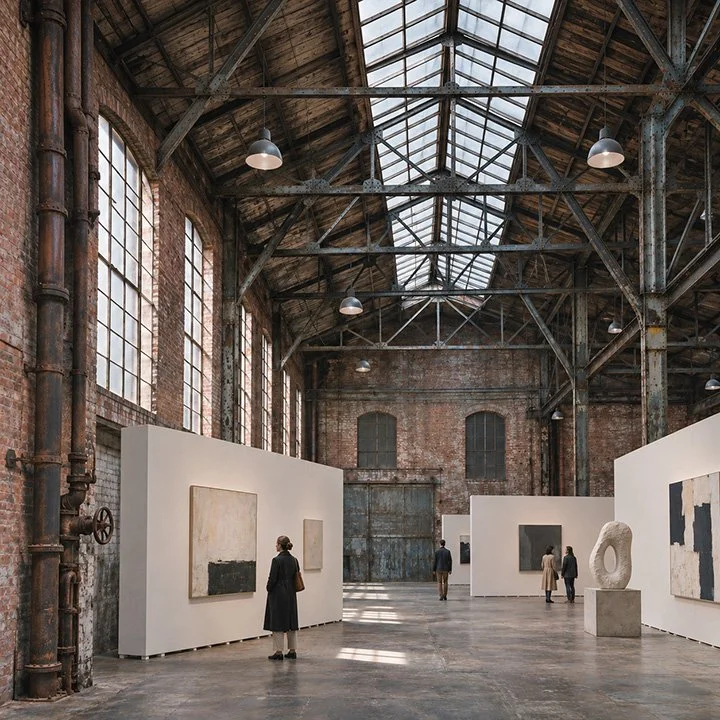
The core gallery program (Gagosian, David Zwirner, Hauser & Wirth, Pace) mostly occupies converted Chelsea garages and warehouses, alongside Tribeca and Lower East Side lofts. High ceilings, wide column spacing, heavy floor loads, and freight access match what galleries naturally need.
The Greenest Building noted one major exception: converting warehouses into apartments often requires so much new material that it scores worse than new construction. Galleries avoid this trap by keeping the raw shell, adding little more than partition walls and lighting.
What a Space for Art Actually Needs
Art requires height, open floors, strong structure, controlled light, and freight access. Old armories, warehouses, and mansions already possess the bones; renovations simply add modern climate control and access. For anyone planning a gallery or cultural space, the lesson from New York's first Art Week is clear: start with what is already standing.
The week's biggest fair, the ADAA Fair, returned to the Park Avenue Armory with 63 exhibitors, running November 12 through November 16