
The Sidewalk is a Machine: How 19th-Century New York Bent the Sun
If you walk through SoHo or Tribeca today, you will likely spot the "purple dots." These small, circular pieces of glass set into the sidewalk have become a sort of scavenger hunt item for tourists and locals.
Most people view them as quirky historic decoration. They are wrong.
These are "vault lights" (or pavement lights). They aren't decoration. They are a sophisticated piece of pre-electric optical engineering designed to solve a massive urban problem using nothing but geometry.
The Problem: Darkness in the Vaults
To understand why these exist, look at the city through the eyes of a merchant in the 1850s. Real estate in New York was expensive. Business owners needed to use every square foot of space, including the "vaults" (storage rooms extending underneath the sidewalks).
The problem was lighting. Before the light bulb, these underground rooms were pitch black. The only option was gas lighting. Gas lamps consumed oxygen, generated immense heat, and posed a catastrophic fire risk in warehouses packed with dry goods like cotton or paper. Merchants needed a way to bring sunlight underground without using open flames or large open grates that would weaken the street.
The Solution: From Ship Decks to Sidewalks
The breakthrough came from the maritime world. For years, sailors had used "deck prisms" (solid cones of glass set into ship decks) to channel sunlight below decks without risking fire. In 1845, an abolitionist and inventor named Thaddeus Hyatt patented a way to adapt this nautical technology for the city street.
However, Hyatt knew that simply putting a flat piece of glass in the sidewalk wouldn't work. Flat glass would only create a harsh spotlight on the floor directly below, leaving the rest of the basement in shadow.
Engineering the Light
Hyatt’s genius was realizing that he didn't need to just let light in. He needed to steer it.
The glass lenses set into the iron frames were not flat panes. They were optical instruments, often shaped as prisms or heavy teardrops on the underside.
Through the physics of refraction, these prisms caught the vertical sunlight entering from the street and bent the rays sideways. This allowed the light to be thrown deep into the back corners of the basement, diffusing a soft glow throughout the entire space.
It was a practical engineering solution that turned the sidewalk itself into a light fixture. A merchant could pack boxes in the basement at noon without burning a single candle.
The Myth of the Purple
The purple color we associate with these lights today is actually a chemical accident. It is a scar of age.
19th-century glassmakers used manganese dioxide to clarify their glass. They didn't know that manganese is photosensitive. After decades of UV exposure, it turns violet.
While the purple is pretty, it represents a degradation of the system. The original engineers wanted pure, white daylight to correctly identify merchandise colors. A "healthy" vault light is actually clear. The purple ones are just the ones that survived long enough to rust chemically.
Why The Machine Stopped
If this system was so smart (zero energy, natural light, durable materials), why did we stop using it?
The romantic answer is that the electric light bulb made them obsolete. The realistic answer is that they were a maintenance nightmare. The systems relied on a watertight seal between glass and iron. As the metal expanded and contracted with New York’s freezing winters and blistering summers, the seals would inevitably fail. Water leaked into the basements and ruined the inventory the lights were meant to illuminate. Furthermore, as the glass wore down from millions of footsteps, it became dangerously slippery when wet.
Eventually, it became cheaper to pave over them with concrete than to maintain a leaking sidewalk.
Conclusion
Today, we spend billions engineering "green buildings" with light shelves and fiber optics to harvest natural daylight. Yet, beneath our feet in SoHo and Tribeca, there is proof that 170 years ago, New Yorkers had already solved that problem. They didn't need sensors or computer chips. They just needed a little bit of geometry and the sun.
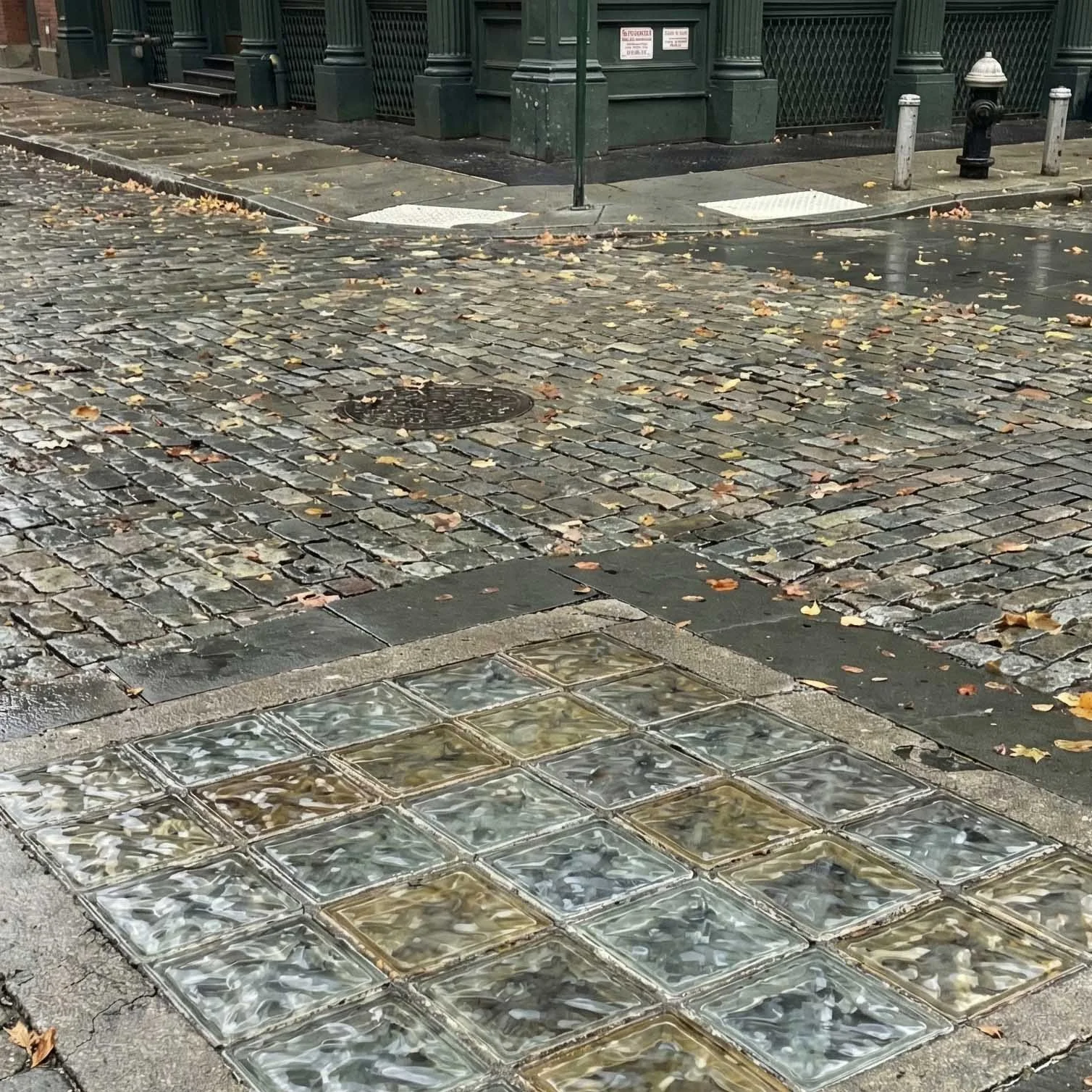
These are "vault lights" (or pavement lights). They aren't decoration.