
The Venice Biennale Opens Next Month. The Show Belongs to a Woman Who Did Not Live to See It.
On May 9, the 61st Venice Biennale opens to the public. It runs through November 22, spread across the Giardini, the Arsenale, and various locations throughout Venice, with 111 artists and 99 national pavilions. By any measure, it is one of the largest art events in the world.
The person who built it died a year before the doors open.
Koyo Kouoh was a Cameroonian-born curator who served as executive director and chief curator of the Zeitz Museum of Contemporary Art Africa (Zeitz MOCAA) in Cape Town, one of the most important institutions for contemporary African art on the continent. She was also the founding artistic director of RAW Material Company, an independent art center in Dakar that she built into a globally respected platform for critical thought and experimental practice. In December 2024, her appointment as curator of the 61st Venice Biennale was made public, making her the first African woman ever selected to lead it. In the months that followed, she chose all 111 artists, defined the theoretical framework, shaped the exhibition architecture, and built personal working relationships with every invited participant. That process reached its peak in April 2025, when she convened her entire core team for an intensive week of work at RAW Material Company in Dakar, leading the sessions herself.
She died on May 10, 2025. She had planned to present the full vision of the exhibition ten days later.
The Show Goes On
The Venice Biennale, with the support of her family, decided to proceed with the show exactly as she designed it. Not adapted, not revised. The team she appointed, advisors Gabe Beckhurst Feijoo, Marie Hélène Pereira, and Rasha Salti, editor-in-chief Siddhartha Mitter, and research assistant Rory Tsapayi, carried it forward through months of online collaboration and follow-up sessions in Venice and Dakar. What opens in Venice in May is Koyo Kouoh’s exhibition.
In Minor Keys
She titled it In Minor Keys, and the title is doing real work. In music, a minor key carries emotional complexity, tension and resolution, things that are felt rather than declared. Kouoh took that idea and turned it into a curatorial philosophy, pushing back against the tendency of large exhibitions to perform urgency, to treat artists as illustrators of the world’s problems. Her Biennale was explicitly not intended to be, in her own words, “a litany of commentary on world events.” It was instead a proposal for what she called a radical reconnection with art’s natural habitat: the emotional, the visual, the sensory, the affective, the subjective.
How the Exhibition Is Structured
The exhibition is organized around undercurrents rather than themes. Shrines, Processional Assemblies, Enchantment, Spiritual and Physical Rest, and Schools, a term reflecting her lifelong commitment to artist-centered institution building. Artists from Salvador, Dakar, San Juan, Beirut, Paris, and Nashville are placed in relation to each other based on resonance and affinity rather than geography. The intended experience is more like moving through a jazz festival than a conventional exhibition. Cape Town-based Wolff Architects developed the scenography, using sweeping indigo banners to mark transitions between zones throughout the Central Pavilion and Arsenale
Where She Stood
Kouoh spent her career arguing that the art world’s center of gravity was in the wrong place. That the voices coming from Africa, from the Caribbean, from cities that do not appear on the standard map of contemporary art, were not peripheral to that world but constitutive of it. RAW Material Company in Dakar was not a regional institution with global ambitions. It was a global institution that happened to be rooted in Dakar because she believed that where you build from matters enormously.
A Posthumous Gift
Her Biennale carries that argument into the largest possible venue. The artists she selected are there because she spent decades in genuine relationship with them, and because she believed that placing them in the same rooms together would produce something that could not be predicted in advance. That is a different kind of curatorial thinking than what the Venice Biennale has often seen. It is also, as it turns out, a posthumous gift.
The Biennale opens May 9. Koyo Kouoh’s name will be on it.
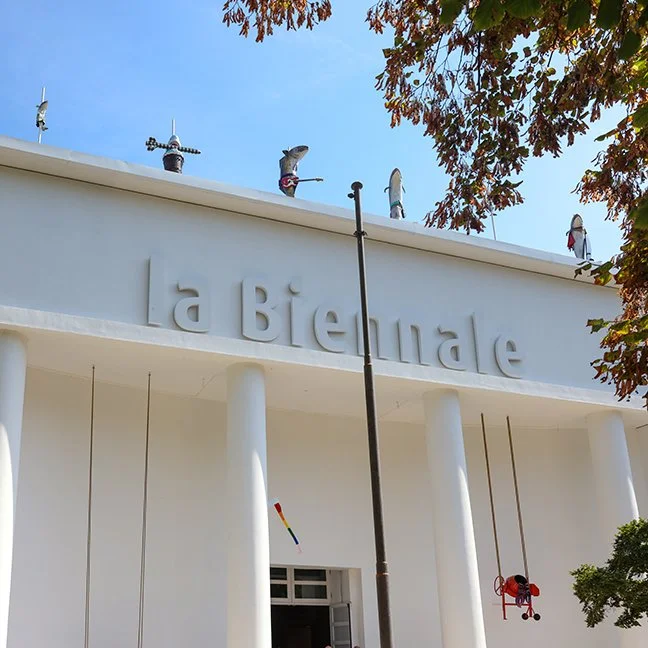
On May 9, the 61st Venice Biennale opens to the public. It runs through November 22, spread across the Giardini, the Arsenale, and various locations throughout Venice, with 111 artists and 99 national pavilions.