
Design with Intention: The Invisible Frontier of Sensory Accessibility
For decades, accessible design was almost entirely physical: ramps, elevators, and railings.
That was essential, but it addressed only visible mobility, today, forward-thinking architects are tackling a more complex frontier: Sensory Accessibility, often called Neurodiverse Design.
A building can be physically compliant and visually stunning, yet still fail its occupants, if the acoustics are harsh, the lighting flickers, or the layout is visually chaotic, the space creates an invisible barrier for a significant portion of the population, including those with Autism, ADHD, PTSD, or sensory processing sensitivities.
We are moving beyond general wellness to deliberately design spaces that minimize cognitive load, making buildings truly supportive of everyone's mental well-being.
The Problem: The "Sensory Soup"
Think about a typical open-plan office or a busy transit hub, they often suffer from a relentless, undifferentiated stream of input.
• Acoustics: Noise bounces off hard surfaces like glass, concrete, and steel, creating a "cocktail party effect" where speech becomes unintelligible and stress hormones spike.
• Lighting: Standard overhead LEDs often have high blue-light content or imperceptible flicker, which can trigger headaches and anxiety in sensitive individuals.
• Visual Noise: Highly reflective surfaces and complex patterns force the brain to work overtime just to "read" the room.
The goal isn't to create a sensory deprivation tank, but to offer a spectrum of environments that gives occupants agency over their stimulation levels.
3 Strategies for Neuro-Inclusive Design
Designing for sensory comfort requires specific, strategic choices that go beyond standard building codes.
1. Acoustic Zoning (Beyond Just Insulation)
Sound pollution is the top complaint in modern shared spaces. While we have discussed materials like cork in previous posts, the new wave of acoustic design uses topography.
• The Trap: Designers are now using suspended felt baffles and PET (recycled plastic) ceiling clouds to physically trap sound waves before they travel across a room.
• The Decompression Zone: Instead of just large break rooms, we are seeing the rise of "micro-libraries" or "quiet pods." These are darker, acoustically deadened spaces designed explicitly for 15 minutes of sensory recovery.
2. Lighting as a Navigation Tool
Harsh lighting doesn't just strain eyes; it creates confusion.
• Matte Over Gloss: To reduce visual glare, designers are swapping polished stone and glossy paints for matte, honed, or textured finishes. This "softens" the visual field.
• Tunable White Light: The gold standard is now lighting that shifts temperature with the circadian rhythm. It starts cool and bright in the morning for focus, then shifts to warm and amber in the late afternoon to signal the brain to relax.
3. Cognitive Flow and Predictability
Anxiety often stems from not knowing what a space is for.
• Transition Signals: We are using distinct changes in flooring texture, such as shifting from polished concrete to carpet tiles, to signal a change in zone. This lets the brain subconsciously anticipate a change in behavior and noise level.
• Biophilic Anchors: Large-scale planting isn't just decoration. It acts as a visual "anchor" that helps people orient themselves in large floor plates without needing confusing signage.
Why This Matters for Urban Design
In dense cities like New York, the exterior environment is aggressively stimulating, the interior must act as a counterbalance.
As we discussed in our piece on Hotel Co-Working Lounges, flexible spaces are the future. But for a flexible space to work, it must be accessible to all brain types, by prioritizing sensory comfort, architects are increasing the long-term usability and value of the building. This is not just a trend, it is the definition of high-performance design.
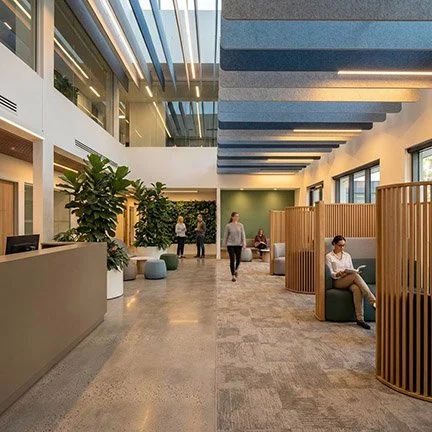
Flexible spaces are the future